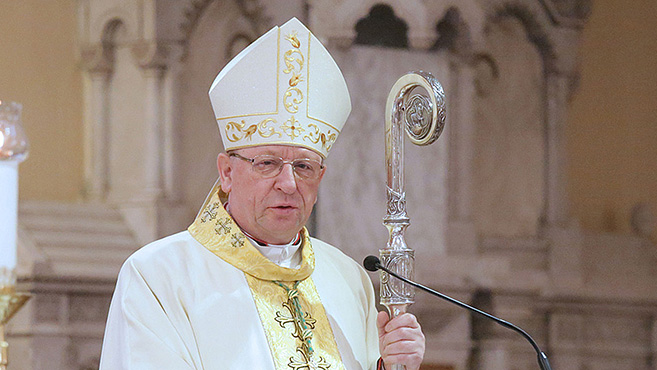
Pope Leo XIV has appointed Monsignor Ferenc Palánki as the new metropolitan archbishop of Kalocsa-Kecskemét, in Hungary. The former bishop of Debrecen-Nyíregyháza, aged 62, has publicly defended marriage between a man and a woman, the family, and the transmission of life, and was part of the Hungarian episcopate that, following the publication of Fiducia supplicans, called for avoiding joint blessings of same-sex couples and couples in irregular situations.
The Holy See announced the appointment on Thursday, September 3, while also communicating that Leo XIV had accepted the resignation submitted by Monsignor Balázs Bábel from the pastoral governance of the archdiocese.
Palánki thus arrives at one of the metropolitan sees of the Church in Hungary after nearly eleven years leading Debrecen-Nyíregyháza, a diocese to which he was appointed by Francis on September 21, 2015. His episcopal career shows a special focus on the family and marriage, along with a long-standing dedication to priestly formation and Canon Law.
Marriage and the transmission of life
Palánki has defended on various occasions a conception of marriage founded on the union between a man and a woman and oriented toward the family and the transmission of life.
During the Week of Marriage held in 2022 in Nyíregyháza, in eastern Hungary, he maintained that marriage is of fundamental importance for “the future of humanity” and referred directly to Genesis: “A man leaves his father and mother, joins with his wife, and the two become one.”
The prelate then stated that marital love “is not simply a feeling,” but involves a decision and a commitment. He also explicitly linked marriage to the transmission of life and the continuity of generations.
This vision also appears in his interventions on the Holy Family. In December 2023, Palánki noted that the mission of spouses consists in helping each other to reach God and to love the children entrusted to them.
In an extensive interview given in 2021 to the media of his diocese, he also recalled the Catholic education he received during his childhood in Csesztve, a small town in northern Hungary. Palánki highlighted that he grew up in an environment where there were “clear and unequivocal” concepts about what marriage meant, what the place of children was, and what it meant to sacrifice oneself for others.
The Hungarian episcopate set limits on Fiducia supplicans
The new archbishop was also a member of the Hungarian Episcopal Conference when it responded in December 2023 to Fiducia supplicans, the declaration of the Dicastery for the Doctrine of the Faith that opened the possibility of imparting non-liturgical pastoral blessings to couples in irregular situations and of the same sex.
The response of the Hungarian bishops came on December 27, just nine days after the publication of the Vatican declaration. The Episcopal Conference began by recalling that Fiducia supplicans “does not change the faith and perennial teaching of the Catholic Church on marriage and sexual morality.”
The bishops noted that priests could individually bless any person who requested a blessing, regardless of their gender identity or sexual orientation.
However, they set a limit on the application of the document in Hungary: they called for “always avoiding the joint blessing” of couples living together without having contracted a valid marriage before the Church, of those in a marriage the Church considered invalid, and of same-sex couples.
In this way, the Hungarian episcopate ruled out that the possibility contemplated by Fiducia supplicanswould translate in the country into blessings imparted jointly to these couples.
More: https://x.com/infovaticana/status/2095468490907885841?s=46&t=IydJ-X8H6c0NM044nYKQ0w








No comments:
Post a Comment