Monday, September 21, 2026

Mexican bishop bans laypeople from presiding over liturgical celebrations

 Niwa Limbu

Aug. 27, 2026


A Mexican bishop has issued a decree restricting laypeople from presiding over certain liturgical celebrations and wearing vestments reserved to the clergy

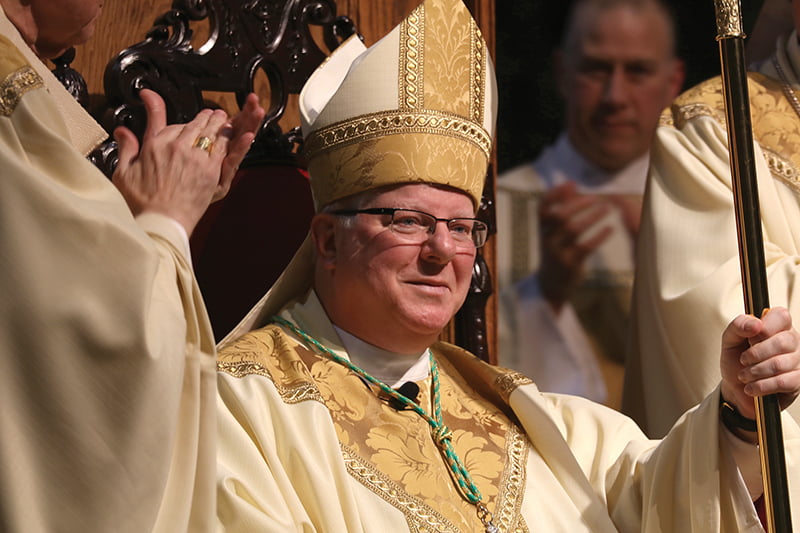
Bishop Carlos Enrique Samaniego López of Texcoco has issued a decree prohibiting laypeople who have not been instituted as acolytes from presiding over celebrations of the Word, funeral rites, sacramentals and other liturgical acts reserved to ordained ministers.

The decree, promulgated on 10 August in the Episcopal City of Texcoco, also prohibits laypeople from wearing the alb and other sacred vestments reserved to the clergy, whether during liturgical celebrations or outside them. 

Bishop Samaniego said the measures were necessary because of “irregular practices that distort the priestly ministry and the sacred character of liturgical acts”. Particular concern was raised about celebrations taking place in halls, gardens and other locations that have not been approved for worship, sometimes involving people who present themselves as ministers despite lacking the necessary authorisation.

The bishop specifically named former seminarians, religious, extraordinary ministers of Holy Communion and other lay faithful who have not been instituted in the stable ministry of acolyte. Such people, the decree states, may not preside over celebrations of the Word, funeral rites, sacramentals or “any kind of celebration or liturgical act proper to an ordained minister”, whether inside churches belonging to the Diocese of Texcoco or elsewhere.

The prohibition is accompanied by a warning about the use of clerical or liturgical clothing. “It is further forbidden, by reason of evident unlawfulness, to use or put on, within or outside liturgical acts, the alb or any sacred ornament or vestment reserved uniquely and exclusively to the clergy,” the decree states.

The regulation is directed not only at laypeople but also at priests serving in the diocese. Bishop Samaniego instructed priests incardinated in Texcoco, as well as priests from other dioceses who are invited to celebrate there, to ensure that liturgical acts are celebrated “validly and licitly”.

Priests are told not to “permit, consent to, or promote illicit practices, abuses, or deceptions” and are instructed to prevent laypeople from assuming responsibilities that belong exclusively to the ordained ministry.

More: https://x.com/niwalimbu1988/status/2092905675168862385?s=46&t=IydJ-X8H6c0NM044nYKQ0w

Sunday, September 20, 2026

Cardinal Sarah says restricting the TLM is ‘harmful, destructive for the Church’


Cardinal Sarah on the perfidious document 'Traditionis Custodes', based on manipulations and lies of the late Argentine pope who cruelly persecuted Catholics who adhered to Tradition:

"It did not seem to me a wise or respectful choice. But Benedict XVI, a man meek as a lamb, allowed himself to be humiliated, and, thus, in silence and prayer, offered his suffering to God to better immerse himself in Christ's pain for his Church and purify it.

The war on those who devoutly participate in the Mass, solely because they prefer one form over another: it is a shortsighted and entirely ideological attitude, therefore not pastoral and not Christian. It is harmful, destructive to the Church."

@SiateSanti

Saturday, September 19, 2026

The meteoric rise of Patrick Kelly

N.B. How many millions did the K of C spend on the disastrous and scandalous “Rapenik” mosaics covering every wall of their DC JPII chapel, which are now completely covered in shame?

 en.news

Leo XIV Appoints to Vatican Former CIA Analyst - $1.9M CEO of Knights of Columbus


Today, Leo XIV has appointed Patrick Kelly, Supreme Knight of the Knights of Columbus, as a member of the Dicastery for the Laity, Family, and Life.

Kelly has moved during his career through the U.S. military, congressional intelligence oversight, the State Department.

CIA for Five Years

Kelly worked for the Central Intelligence Agency for five years as an analyst after graduating from Marquette University in 1985.

He subsequently graduated from Marquette Law School, served as a Navy JAG, worked at the Justice Department's Office of Intelligence and Policy Review, and became legislative counsel to the House Permanent Select Committee on Intelligence.

At the Intelligence Committee, his chief responsibility was the annual Intelligence Authorization Act.

From Washington to Catholic Institutional Leadership

After Kelly's CIA/DOJ/House Intelligence work, he served at the State Department as senior adviser on international religious freedom and was its principal interlocutor with the Holy See. Then, in 2006, he moved directly into the Knights as VP for Public Policy.

Kelly became member of the board of the Knights of Columbus in 2013 and Deputy Supreme Knight in 2017. In 2021, he succeeded Carl Anderson as CEO, completing a 15-year rise through the organization's senior ranks.

Kelly accumulated senior positions in several major American Catholic institutions. He chaired the March for Life Education and Defense Fund from August 2012 until March 2021.

$1.9 Million in Reported Compensation

The latest publicly available IRS-derived filing for the Knights of Columbus reports $1,851,231 in reportable compensation for Kelly as “Director/Supreme Knight,” plus $50,356 in “other compensation”.

His reported compensation has risen considerably since he became Supreme Knight:
2021 $1,159,239
2022 $1,639,096
2023 $1,417,331
2024 $1,851,231

Founded in 1882 as a Catholic fraternal benefit society with a particular mission of protecting widows and orphans, the Knights today combine their activities with a vast insurance and investment operation. The latest filing reports approximately $31.2 billion in assets, $28.1 billion in liabilities and $3.08 billion in net assets.

Seven-figure compensation for the Supreme Knight predates Kelly. His predecessor, Carl Anderson, also received compensation packages reaching or exceeding these levels.

Access to the Vatican

As Supreme Knight, Kelly had regular direct access to Pope Francis: in October 2021, April 2022, April 2023, January 2024 and December 2024. Kelly used the meetings to brief Francis on Knights initiatives including humanitarian relief in Ukraine, evangelization, charitable programs and Catholic formation.

Kelly met the future Leo XIV in 2023, shortly after Prevost became prefect of the Dicastery for Bishops.

Following Prevost's election on May 8, 2025, Kelly issued an unusually expansive statement of institutional loyalty. Speaking for the Knights, he declared: “I pledge our loyalty to Pope Leo XIV,” and said, “The Knights of Columbus will always stand in solidarity with Pope Leo XIV.” Kelly added the new pope's priorities would shape the organization itself: “As it was with his predecessors, the pastoral priorities of Pope Leo XIV will guide and inform everything we do.”

Leo XIV received Kelly in an audience in July 2025 and again in October.

Friday, September 18, 2026

Harping on Natalie

By Abe Greenwald


When it comes to Donald Trump, there’s no such thing as a small story. Even with the war in Iran, the coming midterms, and the flap over the White House ballroom, Natalie Harp would become a household name. 


All the fuss began a week and a half ago, when Senator Jon Ossoff of Georgia made a dig about the two of them. Trump, he said, “wants to build his ballroom and travel with Natalie on their apparently defenseless flying palace gifted by the emir of Qatar." Ossoff was referring to Trump’s covertly switching planes on his return from Turkey in July. The president had left Marco Rubio (and others) on the possibly targeted Air Force One while making off with a small group including Harp.


This became a juicy story for several reasons. Harp is an attractive young woman who's always at Trump’s side, and Ossoff seemed to be insinuating that there’s something inappropriate about their mutual fondness. And when Ossoff, a possible Democratic contender in 2028, then denied that he was implying anything of the sort, a bipartisan game of gotcha was underway. While Republicans voiced their disgust over Ossoff’s innuendo, Democrats and liberal media went digging into Harp.


Which is interesting. Because while the left went looking for dirt in the life and letters and family members of a young woman who had survived bone cancer, lost her father to suicide, and committed the crime of working for Trump, feminists were beginning to organize in support of Lindsay Clancy, a suburban mother who had killed her three small children.  


That’s just an aside I couldn’t resist. What’s more surprising is that the tale of the president and his loyal aide makes Trump look better than any story I’ve ever read about him.


Natalie Harp was diagnosed with a rare bone cancer around 2015, and chemotherapy proved ineffective. In 2018, Trump signed the Right to Try Act, which allows gravely ill patients to try experimental medical treatments that aren’t yet approved by the FDA. Harp availed herself of one of these treatments and credits it (and Trump) with saving her life. 


In 2020, Harp’s father killed himself. She wrote in a 2023 letter to Trump, “Thank you for always being there for me—I’ll never forget when you made that promise to me after losing my Dad...” She doesn’t spell out what the promise was, but later in the same letter, there’s this: “Thank you for being my Guardian and Protector in this Life.” 


I’m going to take a wild guess and say that Trump had promised to look out for Harp after her father died. 


The thing is, he made good on it. Not only is she by his side at the White House, but when the presidential entourage was exposed to potential danger, Trump was sure to include her under his protective umbrella.


Had Donald Trump ever looked so wise, warm, and dependable? He rightly authorized the use of experimental treatments on the seriously ill, seemingly saving Natalie Harp’s life. When she met with further tragedy and lost her father, Trump apparently pledged to step in as a kind of surrogate protector—and, boy, has he followed through. 


The media have made a lot out of the flowery and slavish praise for Trump in Harp’s letters. “You are all that matters to me,” “I never want to bring you anything but joy,” “I don’t want to ever let you down,” and so on. If Trump had done for me all that he’s done for her, my love letters to the man would make hers look like the dashed-off scribblings of an ingrate. 


So, for the love of God, leave the woman alone. 


Abe Greenwald is the executive editor of COMMENTARY.

Thursday, September 17, 2026

How the Muslims Impaled the Christian Greeks

 In Constantinople, the French academic doctor Pitton de Tournefort (18th century), witnessed the impalement of the Christian Greeks from the Muslims: "They lay the victim face down, after tying his hands behind his back, place a donkey saddle on his back, and two of the executioner's assistants sit on it to completely immobilize him. Another one holds his head pressed to the ground with both hands. A fourth assistant tears open the back of the victim's trousers with scissors. Then the executioner drives the stake, a wooden spit, as deep as possible. Next, he takes a wooden hammer and strikes the stake until the sharp end emerges at the chest. They then lift the stake upright and plant it in the ground. And as the poor wretch suffers, the Turks mock him, ridicule him, and call on him to convert to Islam and embrace the Muslim faith."    

Pouqueville also recounts the tragic end of the Greek Thymios Vlachavas from Thessaly, following the uprising of 1808. He saw him in Ioannina, bound to a pole in Ali Pasha's courtyard: "calmer than the tyrant who was enjoying his torment, he looked at me with a serene gaze, as if wanting to make me a witness to the triumph of his supreme hour. He endured the executioner's blows without groaning or complaining. And the limbs dragged through the streets of Ioannina showed the terrified Greeks the remains of the last captain of Thessaly."    

Kandyloros reports that the Muslim Kehaya-Bey "disembarked in Kalamata in 1805 carrying twenty thousand stakes for the impalement of the Greeks. He advanced inland, captured and impaled about six hundred of them."    

Another form of torture was "the hooks." They consist of a scaffold erected at the entrance of cities. The executioner hoists the condemned man high on a pole using a pulley. Below the pole are fixed hooks. Then he suddenly releases the rope, and the condemned man falls with all his weight onto the hooks, impaling himself sometimes in the chest, sometimes in the armpits, or elsewhere on the body. And they leave him there to die. Often death comes after three days.    

All these were inflicted on the Greeks who refused to embrace Islam and Muhammadanism.

BREAKING: Netherlands Euthanizes Disabled 2-Year-Old Child

N. B. That the darkness of evil may not also envelope us we must continue to shine the light by speaking the truth. Every human life is sacred. No exceptions.

NEWS
Featured Image
A disabled 2-year-old child has been euthanized in the Netherlands, even though the toddler was not dying. But that didn’t stop Dutch officials from confirming that everything was done legally.

A Dutch review committee has concluded that a doctor acted with due care in the country’s first euthanasia of a child under 12: a nearly 2-year-old with severe disabilities whose life was ended late last year.

The child was almost 24 months old and could not communicate. The child did not — and could not — ask to die. 

Wednesday, September 16, 2026

The prayer of the pre-55 Breviary: how and why.

“The pre-1955 Roman Breviary is a superior aid for a Catholic priest because it forms the heart according to the mind of the Church’s great tradition: one of costly praise, transcendent orientation, and readiness for sacrifice — Sursum corda. It rejects the modern idols of brevity and convenience in favor of depth, mystery, and fidelity. Just as medieval cathedrals outshine functional 1960s churches in expressing the Catholic faith, so, too, the older Office surpasses its successor in helping to sanctify the priest. The martyrs portrayed in Un Dios Prohibido stand as testimony: the pre-1955 spirit produced martyrs; the trajectory toward 1961 helped shape reformers. For priests seeking to pray not merely efficiently but to consecrate time, the pre-1955 Breviary is the better choice—a cathedral of the Hours.”

Why Should I As A Priest Pray the Pre-1955 Roman Breviary?

My Response.

“We are Jesuit” the new battle-cry of evil?

 President of Students for Life American told by pro-abortion students “we are Jesuit”


Thomas Edwards

Sep. 16, 2026


Students carrying “#Iloveabortions” signs protested the arrival of Students for Life America president Kristan Hawkins at Catholic Gonzaga University, where she had been prevented from setting up a pro-life table

The president of Students for Life America, Kristan Hawkins, was greeted by protesting students when she arrived at Gonzaga University in Washington. She had intended to set up a table to promote Students for Life America and speak with students about the pro-life movement. However, she was banned from setting up the table and instead limited to giving a talk which only students who had registered in advance were permitted to attend.

As Hawkins walked towards a university building, she was greeted by a group of students holding signs bearing slogans including “#Iloveabortions”. Among the group was a woman who introduced herself as Brooklyn and described herself as the “reproductive justice president”. The student was carrying a sign stating “let’s talk”, but Hawkins was told that the invitation was aimed at students and that the protesters did not want to speak to her or her team.

When Hawkins pointed out that the students were supporting abortion at a Catholic university, the students burst into laughter and a man among them replied: “We are Jesuit.”

Hawkins responded by explaining that the Jesuits are a Catholic religious order, telling him: “You are actually Catholic.” Another student replied: “Not every order of Catholics focuses on education, and we do.” When the “reproductive justice president” stated that “you can be Catholic and not be pro-life”, Hawkins responded: “Well, then you would be sinning and you would need to go to confession.”

Tuesday, September 15, 2026

TLM in Amsterdam


Mgr. Hendriks of Haarlem-Amsterdam will celebrate his first Pontifical Latin Mass in the 1962 Rite on the 20th of September in Amsterdam.

@RobbertLeusink

The crisis of the modern world


“The modern world is undergoing an extraordinary spiritual crisis. People are searching for meaning. Young people are searching for an identity. Loneliness is on the rise. Families are breaking down. Technology is penetrating ever more deeply into human existence. Pornography distorts sexuality. Materialism fails to satisfy. Climate change is becoming a surrogate religion for many. People are afraid of death, yet they hardly know what they are living for anymore.

And in the midst of that world, the Church possesses something extraordinary. It possesses the Gospel. The sacraments. The Eucharist. Confession. Two thousand years of wisdom. Scripture. The Church Fathers. Thomas Aquinas. Augustine. The mystics. The saints. An unrivalled tradition of art, music, philosophy, morality and spirituality. And above all: Jesus Christ.

The world is not waiting for yet another organization to listen to it. There are already enough of those. The world is waiting for someone to tell it why it was created.”

Bishop Robert Mutsaerts (August 13, 2026)

Monday, September 14, 2026

My Appeal to Pope Leo XIV: The TLM Is Easier for Me to Actively Participate In

Will appeals from the laity, begging Pope Leo XIV to restore Summorum Pontificum, be heard?


  • I recently listened to Michael Knowles’ interview with Cardinal Raymond Burke. Toward the later part of the interview, there was a discussion on the Traditional Latin Mass. His Eminence said:

    I think that the most important thing is for those who love the Traditional Latin Mass [TLM] to make known to their bishops, and to the Holy Father most of all, their desire to worship according to this form, and that they’re not calling into question the validity of the Second Vatican Council. (32:57)

    Upon hearing this, I was inspired to send a letter to the Holy Father in accordance with my canonical right and obligation (CIC, can. 212, §2). However, that canon says that our opinions should not only be made known to the “sacred pastors” but also to “the rest of the Christian faithful.” In this spirit and as a participation in “synodal dialogue,” I desire to share in more detail what I sent to Pope Leo XIV: I desire to worship with the TLM because I find it easier to understand and participate in.

    I was raised Catholic and attended Catholic high school, but I didn’t truly believe or embrace the Faith until I was in college. The parish I grew up in was a typical but not extreme “spirit of Vatican II” church. I found Catholicism (as I knew it) to be uninteresting, unreasonable, and uncomfortably silly. This dramatically changed when I was exposed to the Church’s intellectual tradition and simultaneously met my closest spiritual mentor, my former pastor and college chaplain. I began to reorient my life around the Truth under his direction.

    But there was a serious stumbling block. I understood why the Church teaches that “the sacrifice of Christ and the sacrifice of the Eucharist are one single sacrifice” (CCC 1367) in terms of argumentation. I trusted that it was sound, but I couldn’t see it for myself. It simply did not “match” my lived experience of the liturgy.

    My pastor invited me and several other college men to attend a Latin Mass on his day off—this was during the time of Summorum Pontificum. It was a low Mass in the ugly convent chapel. I had no idea what he was saying or doing. I thought it would be the “regular” Mass in Latin. However, I quickly perceived with intense curiosity that the form of prayer was different than anything I had experienced. When that consecrated host was elevated, it clicked. For the first time, I realized I truly was at Calvary.

    More: https://crisismagazine.com/opinion/my-appeal-to-pope-leo-xiv-the-tlm-is-easier-for-me-to-actively-participate-in

Sunday, September 13, 2026

The “traditional character” of Pope John XXIII


Cardinal John Heenan on the Traditional Character of Pope Saint John XXIII:

“Pope John was an old-fashioned Catholic of the ‘garden-of-souls type.’ He read his Faber, and no doubt prayed the Litany to the Most Sacred Heart of Jesus regularly; he was not an original thinker. It was Pope Pius XII — not Pope John XXIII — who permitted married pastors to become priests, who changed the eucharistic fasting rules, and who introduced the evening Mass. Pope John was no innovator. He did not set any great reform in motion. His achievement lay in teaching the world of the 20th century how small hatred is, and how great love is.” 

- Westminster Cathedral Chronicle, (July 1964)


Heretics and idolators shall be shut out of the Kingdom

N.B. It is a heresy to hold that the Church’s moral teaching is “wrong and needs to be changed”.

It is a heresy to offer a so-called LGBTQ Mass”. There is no such thing.

It is a heresy to contradict the Catechism by saying there is no such thing as private property.

Those who love falsehood, those who love error, cannot also at the same time love Christ.


From the Holy Gospel according to Luke

Luke 14:1-11
At that time: As Jesus went into the house of one of the chief Pharisees, to eat bread on the Sabbath-day, they watched Him. And, behold, there was a certain man before Him, which had the dropsy. And so on.

Homily by St. Ambrose, Bishop of Milan.
Bk. 7 on Luke XIV

Now is healed this man sick of the dropsy, in whom too much watery matter had well-nigh drowned the functions of life, and quenched the fire of understanding. Anon, a lesson is given in lowly-mindedness, when it is forbidden to the guests at a marriage feast to go and sit down unasked in the highest room, albeit the Lord spake gently, that the teaching of courtesy might forestall a harsh rebuke, reason prevail by dint of persuasion, and the desires be bent to follow the instruction. And upon this, as next-door neighbour, cometh courtesy, which is so called by the Lord, when it is shown to the poor and weak, since to show it to them from whom we are to receive aught, is but a movement of self-interest.

 Lastly, as to a soldier that hath served his full time, is apportioned a reward for esteeming lightly of riches so he only can inherit the kingdom of God, whose soul is not given to seek after lower ends, and who purchaseth not to himself earthly possessions whereas the Lord saith: “Sell that thou hast, and follow Me.” Matth. xix. 21. Neither can he gain it that buyeth oxen, which beasts Elisha slew and gave unto the people. 3 Kings xix. 21. Neither can he win it which hath married a wife and therefore cannot come, for “he that is unmarried careth for the things that belong to the Lord, how he may please the Lord but he that is married careth for the things that are of the world, how he may please his wife.” 1 Cor. vii. 32, 33. Not that this is to be taken for blame of marriage, but only that virginity is the more honourable way, since “the unmarried woman” and the widow “careth for the things of the Lord, that she may be holy both in body and in spirit.” 34-

But in all fairness, having thus spoken concerning widows, let us betake ourselves again among the married, and join with them in entertaining the opinion which is held by so many, that there are only three classes of men who are shut out from the great supper named in the gospel, which three classes are Heathens, Jews, and Heretics. And therefore it is that the Apostle warneth us that we “walk not as other Gentiles walk,” in malice and bitterness, and uncleanness, and covetousness, and so have no entry into the kingdom of Christ, since “no unclean person, nor covetous man, who is an idolater, hath any inheritance in the kingdom of Christ and of God.” Eph. iv. 17, v

Saturday, September 12, 2026

GK Chesterton on “Feminism”


“Feminism is mixed up with a muddled idea that women are free when they serve their employers but slaves when they help their husbands.”

- G. K. Chesterton

Friday, September 11, 2026

The truth about the novus Ordo Missae from the man who best knew Paul Vi


“The French philosopher and writer Jean Guitton was the closest lay friend and key confidant of Pope Paul VI (Giovanni Battista Montini). Their intellectual and spiritual relationship lasted for decades, allowing him to capture the pontiff's intimate thoughts in fundamental works of 20th-century Catholic literature that today are left in oblivion, hidden due to the revealing nature of their content. 

“Paul VI and Guitton met in the 1930s; it was a very close and public friendship. They maintained deep correspondence and constant meetings for more than 27 years. Thanks to his great closeness with the Pope, Jean Guitton was the first layperson invited to actively participate in the sessions of the Second Vatican Council. 

“In 1967 Guitton wrote a book titled Dialogues with Paul VI: It was a revolutionary work, marking the first time in history that a Pope openly dialogued with a layperson for a book. In 1979 he wrote another book; Paul VI Secret after the Pope's death, this book compiles Guitton's personal notes on the pontiff's confidences, doubts, and sufferings.

“Jean Guitton's statements about the history of the Novus Ordo Missae (the New Mass promulgated by Paul VI in 1969) are rarely mentioned, rather concealed, and this is because, as the Pope's closest and most intimate lay friend, they carry particular and immense importance.

“During an interview broadcast on French radio on December 19, 1993, Guitton stated the following about the liturgical revolution with the creation of the Novus Ordo Missae and the reasons for its creation, which his friend, Pope Paul VI, had confided in him: 

"’...Paul VI's intention was to make the Mass as similar as possible to the Calvinist worship, making Protestants feel comfortable with the new Mass.

“‘It was designed with the intention of eliminating everything that identified the Mass as unequivocally Catholic, everything that gave it a character of Sacrifice, everything that harmed Protestants.

“‘To make the Mass seem more like a fraternal gathering, a dinner among brothers...’”

“Jean Guitton also acted directly as a mediator and messenger for Pope Paul VI with Monsignor Marcel Lefebvre. Both Paul VI and, later, John Paul II entrusted him with the mission of interceding with Monsignor Lefebvre to try to stop and close the seminary in Écône, Switzerland.

“Guitton goes so far as to admit in his book that, deep down, Lefebvre was right in defending that the truth of the Church cannot change.

“On another occasion, Guitton asked Paul VI why he did not grant an exception or concession to maintain the Traditional Apostolic Mass in Latin for those who requested it; Pope Paul VI responded sharply:

"’ That, never! (...). The so-called Mass of Saint Pius V has become—as can be seen in Écône—the symbol of condemnation of the Council. This is something I will never accept, under any circumstances. If I consented to this exception, the entire Council would be called into question. And, consequently, its apostolic authority.’

“Paul VI's sharp response appears in the work "Paul VI Secret" (Paul VI secret, originally published in French in 1979). In this text, Jean Guitton meticulously compiled the detailed notes, diaries, and correspondences from his private meetings with the Pope over 27 years of deep friendship.”

N.B. In fear of the fragility of the Council, and its legitimacy, the organic traditional and apostolic liturgy must be replaced by an on-the-spot product ecpressly designed to avoid offending heretics. Not Catholic.


Oremus


Thank you for visiting.

Followers

Kamsahamnida, Dziekuje, Terima kasih, Doh je, Grazie, Tesekur, Gracias, Dank u, Shukran

free counters