Speculation around Leo XIV and the course of his papacy continues relatively unabated. The first Pope from the U.S. has so far conducted a pontificate marked by notable discretion, especially when contrasted with that of his predecessor.
For many Vatican analysts Leo’s major appointments in the Roman Curia will be the most telling, but so far he has only filled the prefect position which was made vacant by his own election. In the face of this relative silence, therefore, and the implicit continuation of some of the Francis-era elements, many have sought to describe Leo as a Francis II while others sought (especially early on) to claim him as an ardent champion for the cause of tradition.
For Professor Roberto de Mattei, Leo is neither. The prominent Church historian and veteran of the Rome scene argued that the Pope displays some characteristics of John Paul II along with Benedict XVI, but that he is fundamentally his own man.
Interviewed by this correspondent for Pelican+, de Mattei urged caution and nuance when trying to understand Leo:
“The first point I would like to stress is that the thesis of those who judge Leo XIV to be a progressive in line with his predecessor seems to me just as superficial as that of those who would like to turn him into a conservative or traditionalist Pope. In my opinion, he reconnects—albeit with the new characteristics of his own personality—to the pontificates of John Paul II and Benedict XVI. He is therefore, at least up to this point, neither a Francis nor a Saint Pius X.”
Leo’s various addresses and speeches have highlighted the themes of unity, while also urging a
Lay-run St. Nicholas Tavelić network quietly forms 300-strong underground community of ex-Muslims seeking sacraments, catechesis and a truly Catholic home.
A portrait of St. Nicholas Tavelić, a 14th‑century Croatian Franciscan martyr who is the namesake for a network that supports Muslim converts (photo: Courtesy of TavNet)
A new support network for converts to the Catholic faith from Islam is flourishing as increasing numbers of Muslims turn to Christ, with many parishes struggling to offer the catechumens the help they need.
The “St. Nicholas Tavelić Network for Morisco Catholics” — TavNet for short — is a lay-run Catholic missionary network that since 2024 has served converts living in Muslim-majority communities or societies where ordinary parish structures cannot easily reach them.
From the tenth conference of this week’s Lenten Retreat. Italian text below.
St Bernard wrote a treatise On Consideration. It enjoyed the widest circulation of any of his works. This may seem odd, for the text is in essence a letter addressed to a specific person in a singular predicament. Bernard wrote it for a confrère of his, an Italian monk named Bernardo dei Paganelli who, already a priest of the church of Pisa, had entered Clairvaux in 1138.
While contemplation deals with truths already known, consideration, in Bernard’s vocabulary, seeks truth in contingent human affairs, where it can be difficult to notice. It can be defined as ‘thought searching for truth, or the searching of a mind to discover truth.’
Considering the problems of the Church, Bernard offers no institutional remedies. He rather advises Eugene to surround himself with good people. The better the Church’s central offices are run, the greater the benefit will be for the Church worldwide.
The qualities Bernard asks him to look out for and cultivate are immortal. Needed are collaborators ‘of proven sanctity, ready obedience, and quiet patience; […] catholic in faith, faithful in service; inclined towards peace, and desirous of unity; […] farsighted in counsel, […] industrious in organisation […], modest in speech’.
Such people ‘habitually devote themselves to prayer, and in every undertaking place more confidence in it than in their own industry or labour. Their arrival is peaceful, their departure unassuming.’
In so far as the Church operates in these terms will she reflect the organisation of the angels’ hierarchies. Whoever considers her then will see her principal mission: that of giving God glory.
To consider earthly necessities rightly, we must seek, through them, what is above. This is not, Bernard tells Eugene, somehow to ‘go into exile: to consider in this way is to return to one’s homeland’
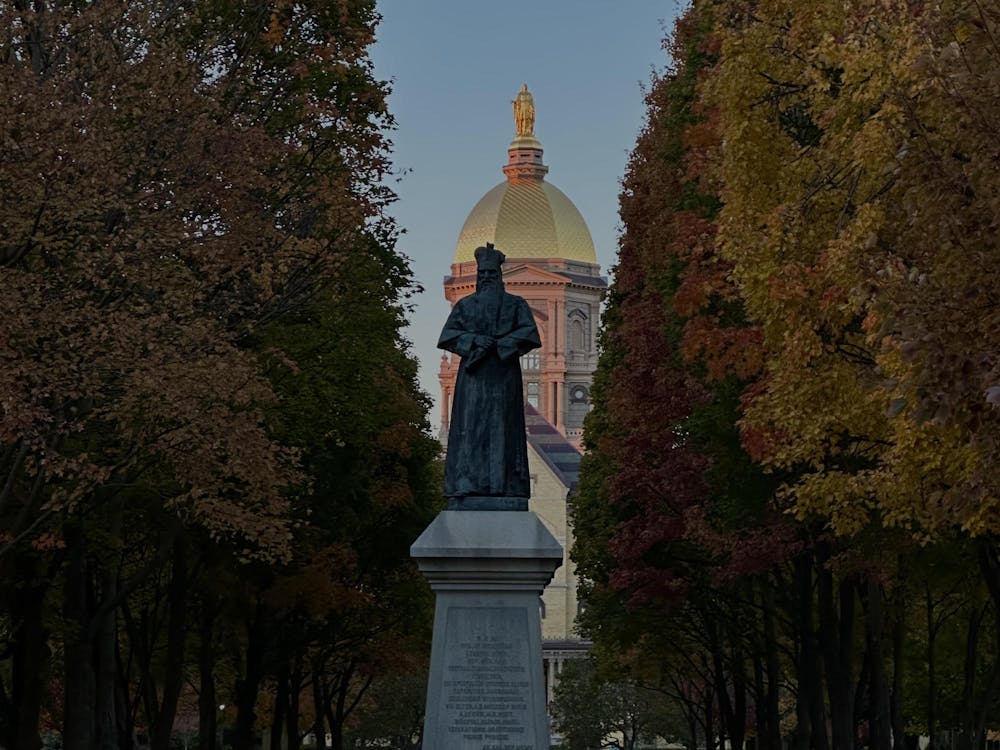
An abortion rights advocate who was appointed to lead the University of Notre Dame’s Liu Institute for Asia and Asian Studies has decided "not to move forward" with her appointment.
In a Thursday message obtained by Fox News Digital, Mary Gallagher, professor of global affairs and the Marilyn Keough Dean of the Keough School of Global Affairs at the University of Notre Dame, wrote, "Dear Keough School community, Today I would like to share that Professor Susan Ostermann, a member of the Keough School faculty who was recently appointed director of the Liu Institute for Asia and Asian Studies, has decided not to move forward as director."
In the message, Gallagher also said, "Susan is a respected scholar of South Asian politics and regulatory governance whose research and teaching reflect the intellectual rigor and interdisciplinary excellence at the heart of both the Liu Institute and the Keough School of Global Affairs. I am grateful for her willingness to serve and for the thoughtfulness with which she approached this decision."
Even organizations such as the US Navy with limited worldly objectives seem to understand the importance of putting the needs of the organization first better than the Church.
The need of a young girl to be seen on the altar, or for her parents to see her there, does not come before the needs of the church for the Sacraments, in particular the Eucharist, and therefore of the priesthood, and therefore also of vocations.
In a state of emergency, and of war, the people always understood the need for sacrifices, the wishes of an individual coming after the needs of the rest.
Bishop Erik Varden on the fourth day of the Lenten Spiritual Exercises for the Holy Father and the Roman Curia says:
“The Church reminds women and men of the glory secretly alive in them. She shows us that present mediocrity and despair, not least my despair at my own persistent failures, need not be final; that God’s plan for us is infinitely lovely; and that God, through Christ’s Mystical Body, will give us grace and strength, if only we ask.
The Church manifests the radiance of ‘hidden glory’ in her saints. They stand as proofs that even illness and degradation may be means providence uses to realise a glorious purpose, bestowing strength on the feeble and making them radiant. The Church channels ‘hidden glory’ in her sacraments. Any Catholic knows what light can break forth in the confessional, in an anointing, at an ordination or a wedding. Most splendid, and in some ways most veiled, is the glory of the Holy Eucharist. What priest, after offering Mass, has not felt what a great musician once said about an instrument in a bright communication of beauty, healing, and truth: ‘death would really be no tragedy: [for] the best of that which is at the centre of human life has been seen and lived through’, his heart on fire with glorious wonder?”
Today the funeral of Quentin Deranque took place, killed by the French extreme left at the hands of the terrorist movement ANTIFA, in a private ceremony reserved for family members.
The English philosopher Roger Scruton explained that he became a conservative after witnessing the student protests of May 1968 in France:
“What struck me most about those students in the streets was, first of all, the sentimentality of their anger.
It was all about themselves; it had nothing to do with anything objective.
Here they were, the spoiled children of the middle class, the baby boomers who had never had to face any real difficulties, shouting at the top of their lungs in the streets, burning the cars belonging to ordinary working-class people whom they pretended to defend against some imaginary oppressive structures erected by the bourgeoisie.
The whole thing was a complete fiction based on the outdated ideas of Karl Marx—ideas that were already obsolete by the middle of the nineteenth century.
They were, if you like, staging a self-written drama in which the central character was themselves.”
“I do not forget that together with my family I came to know about Christ thanks to some French missionaries. My parents and I believed thanks to Europe. My grandmother was baptized by a French priest as she was leaving this world. I might never have left my village if the Holy Ghost Fathers had not spoken about Christ to some poor villagers.
“How can we Africans comprehend the fact that Europeans no longer believe what they gave us so joyfully, in the worst possible conditions? Allow me to repeat: without the missionaries who came from France, I might never have known God. How can we forget this sublime heritage that the Westerners seem to leave to gather dust?”
The David Horowitz Freedom Center spent a lot of time bringing attention to the Muslim genocide of Christians in Nigeria. Before his death, Charlie Kirk spread our work around, and the Trump administration fortunately listened. And yet it also unfortunately adapted a false narrative in which the tremendous genocide of Christians was just the work of the local Al Qaeda. And that’s simply not true. These are the broader work of the local Muslim ‘Fulani’ population.
Driving through the vast, scorched landscape, I hear the words that have followed me all day. ‘They roasted the pastor and his wife alive in the church. We heard their screams.’
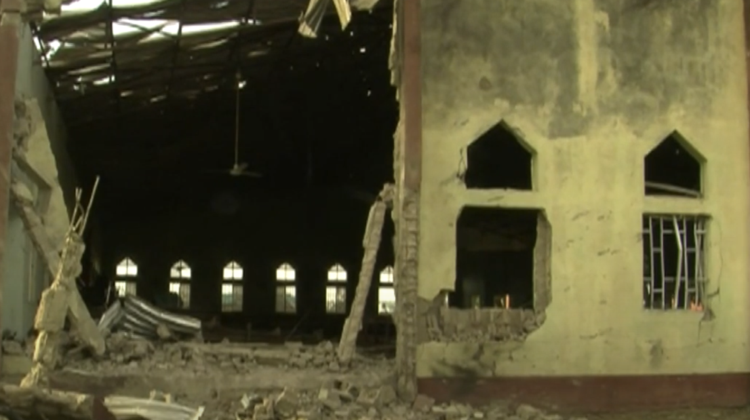
Bricks lie scattered in the scrub. Concrete blocks jut from the earth like jagged teeth. Roofs have collapsed inward.
And then come the churches.
Burned-out shell after burned-out shell. Crosses broken. Windows blown through. One has been gutted by fire, another reduced to rubble.
It’s as though someone has tried to erase every visible sign of Christianity from this land.
For more than two decades, this stretch of Nigeria’s Middle Belt – the faultline where the largely Muslim north meets the predominantly Christian south – has convulsed in recurring waves of bloodshed…
In the face of all this, calling the violence here merely a ‘farmer–herder conflict’, as government officials try to do, begins to sound like a diplomatic euphemism. It’s true that land is in high demand and grazing routes are contested. But that explanation alone feels inadequate when you witness for yourself the ruins of so many churches – and hear the stories of so many slaughtered Christians.
We arrive in the village of Gwet, parking by a collection of abandoned houses, destroyed fields and another ruined church. In truth, we’re not exactly welcome. The people who committed these atrocities – Muslim Fulani herdsmen – can be seen in the distance: the new, unchallenged masters of this once devoutly Christian area.
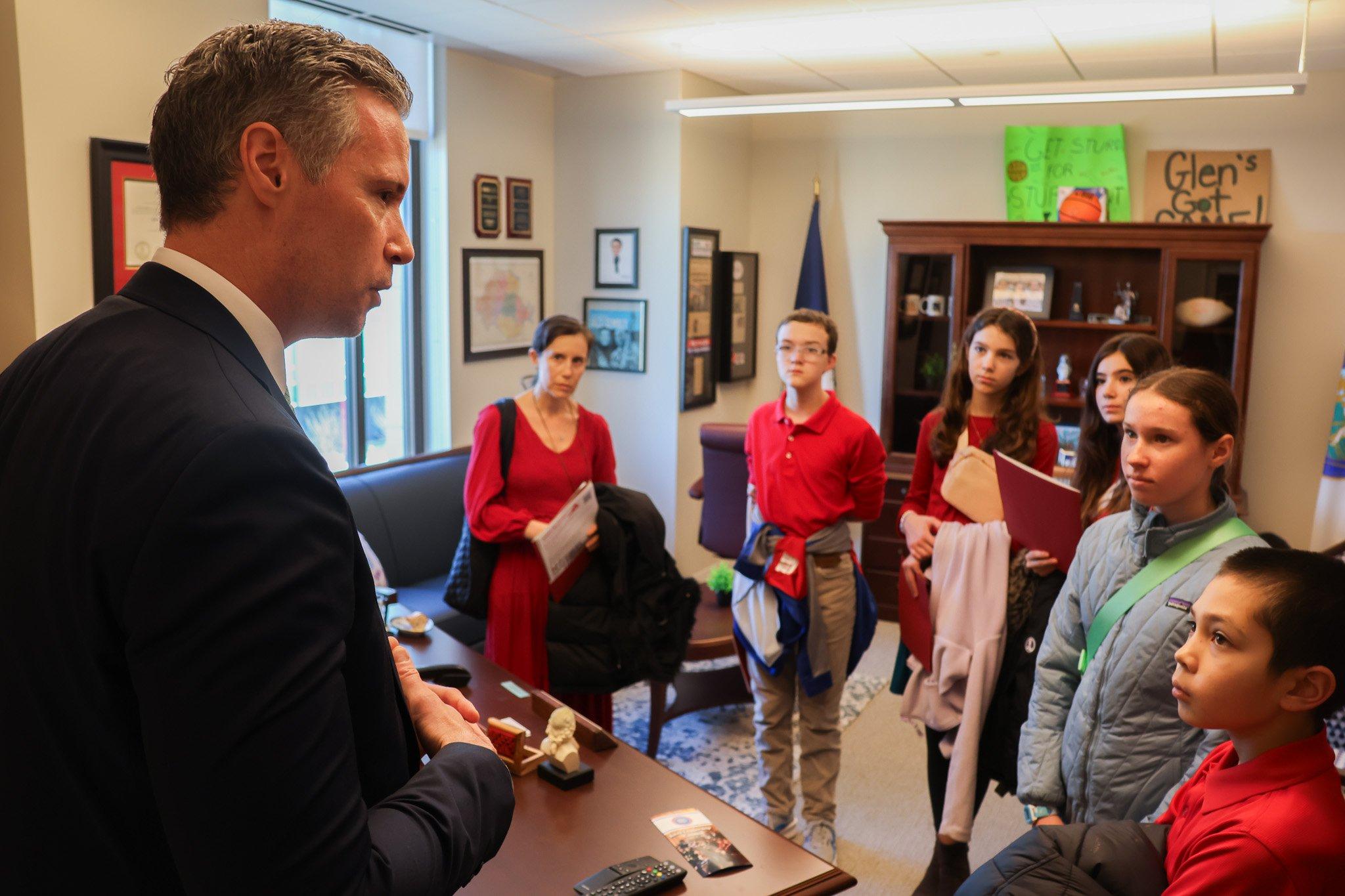
Republican Virginia State Sen. Glen Sturtevant meets with students in his office at the General Assembly Building in Richmond during Virginia Pro-Life Day Jan. 15, 2026. (OSV News photo/Claire Bebermeyer, Diocese of Richmond)
RICHMOND, Va. (OSV News) — The Virginia General Assembly has sent a sweeping amendment enshrining a “fundamental right” to abortion in the Constitution of Virginia to a statewide referendum on the November ballot.
If the voters approve the amendment, it will establish virtually unlimited abortion at any stage of pregnancy as a “fundamental right” in Virginia’s constitution.
Virginia Pro-Life Day
The amendment passed the General Assembly Jan. 16 despite the best efforts of the bishops and more than 600 pro-life advocates who met with legislators a day earlier, on Virginia Pro-Life Day.
Two proposed changes to the amendment were voted down: first, a proposal to keep the current parental consent law enforceable; second, a “born-alive” protection that would guarantee the right to medical care for a child born despite an attempted abortion.
The parental consent law currently upholds parental rights in decision-making for minors under 18 on a variety of issues, including abortion, though there is a judicial override on abortion.
‘Shocking to the conscience’
Richmond Bishop Barry C. Knestout joined Arlington Bishop Michael F. Burbidge in calling the amendment “radical,” “extreme” and “shocking to the conscience” in a Jan. 16 statement.
“We will be deeply engaged in the work of helping to educate voters on these proposed amendments, and we will fight the extreme abortion amendment with maximum determination,” said the bishops.
The state Legislature first approved the proposed amendment in early 2025, but by Virginia law, the proposal must pass in two consecutive state legislatures. The House of Delegates approved the 2026 version of the amendment Jan. 14.
‘Will be most extreme in nation’
“It will be the most extreme abortion amendment in the nation. This prevents the state from regulating abortion in any way, shape or form, all the way down to inspecting clinics for basic safety standards,” said state Sen. Glen Sturtevant, a Republican, who belongs to St. Edward the Confessor Parish in Richmond.
The amendment goes far beyond even what Roe v. Wade previously allowed and provides no protections whatsoever for preborn children. It does not include any age restriction or safety standards. Besides severely jeopardizing the parental consent law, it will also impact conscience protections for health care providers.
“This amendment was drafted by very smart lawyers to look innocuous and friendly, so that people will say, ‘Oh, that’s nice. Reproductive freedom — who could be against that?'” said Sturtevant. “In practice, this amendment is going to allow a human trafficker, or an adult that gets a minor pregnant, to bring that young person to this state for an abortion. This amendment would protect that person from prosecution.”
Continuation ✠ of the Holy Gospel according to Matthew
℟. Glory be to Thee, O Lord. Matt 5:43-48; 6:1-4 At that time, Jesus said to His disciples, You have heard that it was said, ‘You shall love your neighbor, and shall hate your enemy.’ But I say to you, love your enemies, do good to those who hate you, and pray for those who persecute and calumniate you, so that you may be children of your Father in heaven, Who makes His sun to rise on the good and the evil, and sends rain on the just and the unjust. For if you love those that love you, what reward shall you have? Do not even the publicans do that? And if you salute your brethren only, what are you doing more than others? Do not even the Gentiles do that? You therefore are to be perfect, even as you heavenly Father is perfect. Take heed not to do your good before men, in order to be seen by them; otherwise you shall have no reward with your Father in heaven. Therefore when you give alms, do not sound a trumpet before you, as the hypocrites do in the synagogues and streets, in order that they may be honored by men. Amen I say to you, they have received their reward. But when you give alms, do not let your left hand know what your right hand is doing, so that your alms may be given in secret; and your Father, Who sees in secret, will reward you.
BREAKING: 1st Detransitioner to Take a Medical-Malpractice Lawsuit to Trial Wins $2 Million Judgement
Fox Varian sued her Westchester, NY, area psychologist and plastic surgeon for the gender-transition mastectomy she got at 16.
I was the only reporter to attend the entire 3-week, historic trial. Subscribe to my Substack to receive an alert about the feature article I have coming out next week in a major publication out about the trial: benryan.substack.com. I cover pediatric gender medicine as a specialty on my Substack.
Sorry to just give just a teaser for now about the case! But I wanted to get the word out about the verdict promptly, the slower pace of feature-article publishing notwithstanding.
The entire case file was put under seal when the trial started (although I obtained all those documents before they was sealed), and all the transcripts from the trial are also under seal. The riveting trial was sparsely attended and there was only one other reporter at the trial; and he only attended for part of it and, as I observed, took few notes. So my own hundreds of pages of notes from the trial will likely remain the only way for the public to learn about the all finer details of what transpired, possibly ever (or until an appeal, should that happen).
In addition to my article coming out in the media outlet soon, I intend to write a lot about what I observed and learned on my Substack over the coming weeks. Stay tuned…
Just discovered this morning while hunting for another title. Too late for me as I already purchased this one at the regular price. Sharing with readers to avail them of the savings. Available now for the low, low price of $19.95. A goodly discount.
First of all, I thank you for receiving me on 12 February, and for making public the content of our meeting, which promotes perfect transparency in communication.
I can only welcome the opening of a doctrinal discussion, as signalled today by the Holy See, for the simple reason that I myself proposed it exactly seven years ago, in a letter dated 17 January 2019.1 At that time, the Dicastery did not truly express interest in such a discussion, on the grounds—presented orally—that a doctrinal agreement between the Holy See and the Society of Saint Pius X was impossible.
For the Society’s part, a doctrinal discussion has always been—and remains—desirable and useful. Indeed, even if we do not reach an agreement, fraternal exchanges allow us to better know one another, to refine and deepen our own arguments, and to better understand the spirit and intentions behind our interlocutor’s positions—especially their genuine love for the Truth, for souls, and for the Church.
This holds true, at all times, for both parties.
This was precisely my intention in 2019, when I suggested a discussion during a calm and peaceful time, without the pressure or threat of possible excommunication, which would have undermined free dialogue—as is, unfortunately, the situation today.
That said, while I certainly rejoice at a new opening of dialogue and the positive response to my proposal of 2019, I cannot accept the perspective and objectives in the name of which the Dicastery offers to resume dialogue in the present situation, nor indeed the postponement of the date of 1 July.
I respectfully present to you the reasons for this, to which I will add some supplementary considerations.
1. We both know in advance that we cannot agree doctrinally, particularly regarding the fundamental orientations adopted since the Second Vatican Council. This disagreement, for the Society’s part, does not stem from a mere difference of opinion, but from a genuine case of conscience, arising from what has proven to be a rupture with the Tradition of the Church. This complex knot has unfortunately become even more inextricable with the doctrinal and pastoral developments of recent pontificates.
I therefore do not see how a joint process of dialogue could end in determining together what would constitute “the minimum requirements for full communion with the Catholic Church”, since—as you yourself have recalled with frankness—the texts of the Council cannot be corrected, nor can the legitimacy of the liturgical reform be challenged.
2. This dialogue is supposed to clarify the interpretation of the Second Vatican Council. But this interpretation is already clearly given in the post-Conciliar period and in the successive documents of the Holy See. The Second Vatican Council is not a set of texts open to free interpretation: It has been received, developed, and applied for sixty years by successive popes, according to precise doctrinal and pastoral orientations.
This official reading is expressed, for example, in major texts such as Redemptor hominis, Ut unum sint, Evangelii gaudium, or Amoris lætitia. It is also evident in the liturgical reform, understood in the light of the principles reaffirmed in Traditionis custodes. All these documents show that the doctrinal and pastoral framework within which the Holy See intends to situate any discussion has already been firmly established.
3. One cannot ignore the context of the dialogue proposed today. We have been waiting for seven years for a favourable response to the proposal of doctrinal discussion made in 2019. More recently, we have written twice to the Holy Father: first to request an audience, then to clearly and respectfully explain our needs and the real-life situation of the Society.
Yet, after a long silence, it is only when episcopal consecrations are mentioned that an offer to resume dialogue is made, which thus seems dilatory and conditional. Indeed, the hand extended to open the dialogue is unfortunately accompanied by another hand already poised to impose sanctions. There is talk of breaking communion, of schism,2 and of “serious consequences”. Moreover, this threat is now public, creating pressure that is hardly compatible with a genuine desire for fraternal exchanges and constructive dialogue.
4. Furthermore, to us it does not seem possible to enter into a dialogue to define what the minimum requirements for ecclesial communion might be, simply because this task does not belong to us. Throughout the centuries, the criteria for belonging to the Church have been established and defined by the Magisterium. What must be believed in order to be Catholic has always been taught with authority, in constant fidelity to Tradition.
Thus, we do not see how these criteria could be the subject of joint discernment through dialogue, nor how they could be re-evaluated today so as not to correspond to what the Tradition of the Church has always taught—and which we desire to observe faithfully in our place.
5. Finally, if a dialogue is envisaged with the aim of producing a doctrinal statement that the Society could accept regarding the Second Vatican Council, we cannot ignore the historical precedents of efforts made in this direction. I draw your attention to the most recent: the Holy See and the Society had a long course of dialogue, beginning in 2009, particularly intense for two years, then pursued more sporadically until 6 June 2017. Throughout these years, we sought to achieve what the Dicastery now proposes.
Yet, everything ultimately ended in a drastic manner, with the unilateral decision of Cardinal Müller, the Prefect of the Congregation for the Doctrine of the Faith, who, in June 2017, solemnly established, in his own way, “the minimum requirements for full communion with the Catholic Church”, explicitly including the entire Council and the post-Conciliar period.3 This shows that, if one persists in a doctrinal dialogue that is too forced and lacks sufficient serenity, in the long term, instead of achieving a satisfactory result, one only worsens the situation.
Thus, in the shared recognition that we cannot find agreement on doctrine, it seems to me that the only point on which we can agree is that of charity toward souls and toward the Church.
As a cardinal and bishop, you are above all a pastor: allow me to address you in this capacity. The Society is an objective reality: it exists. That is why, over the years, the Sovereign Pontiffs have taken note of this existence and, through concrete and significant acts, have recognised the value of the good it can accomplish, despite its canonical situation. That is also why we are speaking today.
This same Society asks you only to be allowed to continue to do this same good for the souls to whom it administers the holy Sacraments. It asks nothing else of you—no privileges, nor even canonical regularisation, which, in the current state of affairs, is impracticable due to doctrinal divergences. The Society cannot abandon souls. The need for the sacraments is a concrete, short-term need for the survival of Tradition, in service to the Holy Catholic Church.
We can agree on one point: neither of us wishes to reopen wounds. I will not repeat here all that we have already expressed in the letter addressed to Pope Leo XIV, of which you have direct knowledge. I only emphasise that, in the present situation, the only truly viable path is that of charity.
Over the last decade, Pope Francis and yourself have abundantly advocated “listening” and understanding of non-standard, complex, exceptional, and particular situations. You have also wished for a use of law that is always pastoral, flexible, and reasonable, without pretending to resolve everything through legal automatism and pre-established frameworks. At this moment, the Society asks of you nothing more than this—and above all it does not ask it for itself: it asks it for these souls, for whom, as already promised to the Holy Father, it has no other intention than to make true children of the Roman Church.
Finally, there is another point on which we also agree, and which should encourage us: the time separating us from 1 July is one of prayer. It is a moment when we implore from Heaven a special grace and, from the Holy See, understanding. I pray for you in particular to the Holy Ghost and—do not take this as a provocation—His Most Holy Spouse, the Mediatrix of all Graces.
I wish to thank you sincerely for the attention you have given me, and for the interest you will kindly take in the present matter.
Please accept, Most Reverend Eminence, the expression of my most sincere greetings and of my devotion in the Lord.
Davide Pagliarani, Superior General
+ Alfonso de Galarreta, First Assistant General
Christian Bouchacourt, Second Assistant General
+ Bernard Fellay, First Counsellor General, Former Superior General
Franz Schmidberger, Second Counsellor General, Former Superior General
“A leading cardinal and former secretary of the Roman Curia has spoken to theCatholic Heraldabout the state of the Church, the role of the papacy, and how Catholics should approach authority.
“Cardinal Gerhard Ludwig Müller, prefect emeritus of the Congregation for the Doctrine of the Faith, described the veneration of the private and political opinions of the late Pope Francis as a “heresy” and said that criticising it was his “duty”. The German prelate insisted that Catholics should not fall into a heretical leaning spiritual posture known as “ultramontanism”, which exaggerates the role and doctrines surrounding the papacy, and said they should remain conscious of the historical context in which such attitudes emerged in the 19th century.”
The loss of sacredness, the lack of centrality of God, the one-sided emphasis on the ‘meal character’ in the Mass since the introduction of the Novus Ordo: all this must be reconsidered!
(LifeSiteNews) — In an interview with Diane Montagna on January 20, 2026, Bishop Athanasius Schneider draws attention to some historical facts about the liturgical reform after the Second Vatican Council, which most bishops and cardinals ignore or are no longer aware of:
The liturgical constitution Sacrosanctum concilium was adopted on December 4, 1963, and provided guidelines for the reform of the Mass and other liturgical rites. It contained theological and pastoral principles. The actual implementation was entrusted to the Pontifical Commission (Consilium ad exsequendam Constitutionem de Sacra Liturgia). On January 27, 1965, a revised form of the order of Mass was published under the direction of the Consilium: Ordo Missae. Ritus servandus in celebratione missae … Editio typica1965. This Ordo Missae legally replaced parts of the Missale Romanum of 1962 and introduced the first changes.
In October 1967, an experimental new Mass (“Missa normativa“) was celebrated in Rome, which had been decided upon by the commission. It was another draft that no longer only slightly modified the 1962 rite. This version was presented by Annibale Bugnini, the secretary of the commission, to the first post-conciliar synod of bishops, but met with divided opinions:
About 71 bishops voted in favor (“placet”)
43 were against (“non placet”)
62 saw it only as a basis for discussion
In other words, this draft was not accepted as binding. It can be said that the majority of the synod fathers rejected the “Missa normativa” in this form and did not give a clear mandate to adopt or pursue this version (several were against it or wanted changes). Nevertheless, the process was not stopped; work on the new missal continued despite the divided response. Over several years, the texts and structure were revised, with the participation of Pope Paul VI himself. On April 3, 1969, the new missal was promulgated by the apostolic constitution Missale Romanum and was bindingly introduced on the first Sunday of Advent (November 30, 1969). This 1969 missal is the so-called Mass according to Paul VI (in ecclesiastical parlance, the “Novus Ordo Missae”). It differs considerably from the editio typica of 1965, which was already celebrated by the Council Fathers and met with no opposition among them. The change in the direction of celebration [ad orientem vs. versus populum] and the people’s altar were not envisaged by the Council.
To summarize:
1965: A revised Ordo Missae was published – a transitional version of the old Mass based on the initial impulses of the Council.
1967: There was an experimental draft (“Missa normativa“), which was not confirmed.
1969: The new missal (Missale Romanum) was promulgated, known today as the Mass according to Paul VI (often called “Novus Ordo Missae”). It implements changes that were rejected by a majority of the Synod of Bishops in 1967.
Card. Burke: "Prophétis meis"
-
Non relíquit hóminem nocére eis: et corrípuit pro eis reges.
Nolíte tángere christos meos: et in prophétis meis nolíte malignári.
-- Sanctae Mariae in Sabbat...
Feria Sexta infra Hebdomadam III in Quadragesima
-
Friday, March 13, 2026
Color: Violet
Penance: Fast & Abstinence
Flowers are not permitted.
Organ: Only to accompany singing
Penitential kneeling.
*Ma...