Wednesday, July 10, 2013

Mertarvik, Alaska

View from the chapel toward Moses' house and the construction site of the new shelter completed by the Seabees and Marines in these weeks.

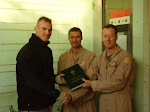
Moses, fourth from left, next to his wife, Marie, their daughter with her husband and three children joined us for Mass on a brilliantly sunny July 7 at 5 pm in the new chapel location in a SWA hut on the top of the hill at Mertarvki near his home.

Preparing for holy Mass in "The Little Chapel on the Tundra"

Thursday, July 4, 2013

"Leaving the ninety-nine": Evangelizing beyond the church doors

Most priests and Catholics meet other Catholics only because tbey show up for Mass on Sundays.  Military chaplains, by contrast, more often meet those Catholics who choose not to practice, as they enjoy the privilege of extended periods of unparalleled access to the most underrepresented group in our churches today: twenty- and thirty-something uncommitted singles.

As an active-duty chaplain for years I lived and worked with this particular age group every day on shipboard and on bases in the United States and Italy.  Now a Reserve chaplain, I spend one weekend a month and two weeks in the summer eating, working, training and sometimes praying with them.

Members of this group, in contrast to previous generations, have less in common with each other based on faith background as opposed to values learned outside of church and beyond practicing Catholic families. They are more likely to oppose Church teaching in matters of marriage, human life, and sexuality and to question the need for worship, sacraments or anything specifically Catholic.  They do believe in God and will on occasion pray with others.  in other words, they are proof that the catechetical emergency is real being as they are the fruit of fifty years of Catholic deconstruction.

Members of this age group who are committed to the Faith are more likely to value Latin, traditional worship and customs and to enthusiastically defend Church moral teaching as if the last fifty years never happened.  A much smaller group within their age cohort, the task of evangelizing their peers will largely fall to them.

Recently on deployment I spoke to a young Mormon Marine who married a Catholic of Mexican background. They have formed a Mormon home together in dramatic contrast to what would have happened fifty years ago: the Catholic party with the support of her priest and family behind her would have insisted on continuing to practice the Catholic Faith.

I also surveyed baptized Catholics who now often refer to themselves more frequently as having been "raised Catholic".  This description could range in meaning from a gentle way of saying that someone has "moved away" from Church or simply to indicate the non-committal approach typical of many young adults. Family break-up through divorce has a decisive effect on whether young people practice their Faith into adulthood.

All of this means that evangelization in the years ahead will require working to preserve access to young people beyond conventional Church functions, approaching, dialoguing and building relationships with young people outside of Mass and other conventional Catholic events and much prayer and patience born of Christ's saving love for them.

Follow Father Kevin M. Cusick on Facebook at Reverendo Padre-Kevin Michael Cusick and on Twitter at MCITL.

The Mass Appeals to Those Who Obey God

By Father Kevin M. Cusick

Ex-Catholics do not always go on only to affiliating with some other ecclesial organization.  Sometimes they also take up a “ministry” of proselytizing Catholics.  One such character who plies his trade on Facebook is John Farina and one of his techniques involves claiming that some Mass-attending Catholics are “secretly bored” and to whom he then offers to reach out with an offer of “help”.

An large ecclesial organization near my church In Maryland is heavily invested in entertainment, evidently in agreement with John that one of the capital sins in religious services is to risk the boredom of the congregants.  They offer meals, movies and other perks to keep people “interested” and active.

Catholics have just as much capacity for fun as anyone else, to include going to movies, having meals and visiting with each other.  Some do it so well that they are accused of taking it to excess.  But why do Catholics not place first priority upon entertainment in our religious services?  Why does the Catholic Mass, when viewed from a certain perspective, seem to knowingly leave worshipers at risk of boredom, relying as it does on repeated texts, music and other elements of the liturgy?

A look at Zechariah chapters 12 and 13 and the way his prophecies are fulfilled in the worship of the Mass as practiced by faithful Catholics can give us some insight.

“Thus says the LORD: I will pour out on the house of David and on the inhabitants of Jerusalem a spirit of grace and petition.”  First comes the work of the Spirit, for we cannot give what we do not have.  The Holy Spirit has been poured out upon the Church, beginning at Pentecost.  Worship of God, knowing and loving God must be done in the Spirit and when one does what the Church does one always does it in the Spirit, to include Sunday worship.  As well, the Scriptures teach that the Spirit is given to those who obey God.  When we obey the commandment to keep the Lord’s Day holy and do so together with the other baptized members of the Body of Christ at our local parish we are given the gift of God’s Spirit.

“  … and they shall look on him whom they have pierced”  You may have noticed that wherever the Mass is celebrated the crucifix is displayed.  That is, an image of the Lord on the Cross is given a place of prominence within the assembly.  When we proclaim God’s Word in Scripture together as His Church and approach His altar of sacrifice we remember that His self-giving is the source of our life.  As well, when the priest holds aloft the consecrated Host during the liturgy of the Eucharist within the Mass we also look on Him who we have pierced but who now lives, having risen from the tomb.  The Eucharistic Christ we behold in the hands of the priest is the Easter Christ, having conquered sin and eath and who offers us a share in His victory.  Christ Himself commanded that we celebrate the Mass as the memorial of His death until he comes.

“ … and they shall mourn for him as one mourns for an only son, and they shall grieve over him as one grieves over a firstborn.”  Zechariah is quite right that the natural reaction to the death of a loved one is to mourn.  Grace builds on nature: when we approach His Cross in order to share in His resurrection we never do so without a measure of sorrow for the suffering the Lord had to endure for our sins.  Thus the Mass always ahs about it a measure of the solemn and the serious, making the idea of entertainment  somewhat ludicrous.  There was nothing entertaining about Calvary.

“On that day there shall be open to the house of David and to the inhabitants of Jerusalem,
a fountain to purify from sin and uncleanness.”  Most wonderfully, the living Christ whom we really and truly receive in the Eucharist is that fountain, for it is from His pierced side as He hung upon the Cross that the living stream of Zechariah’s prophecy flows through the Church throughout history and into each of our lives.  Christ purifies from sin and uncleanness through the power of His mercy.  A sublime joy through which we “lift up our hearts” is the right and proper disposition for such a moment above all others and thus for the celebration of Holy Mass.

These reasons, just some of the many, are why we celebrate holy Mass above all on the Lord’s Day: “It is right and just.”

(Subscribe to public updates by Fr. Cusick on Facebook at Reverendo Padre-Kevin Michael Cusick or follow on Twitter at MCITL. Visit Meeting Christ in the Liturgy at mcitl.blogspot.com for teachings from the Catechism of the Catholic Church paired with the Scriptures of Holy Mass for every day of the week. Fr. Cusick blogs at APriestLife. blogspot.com and you can e- mail him at mcitl.blogspot.com@gmail.com.)

Sunday, June 30, 2013

"The Son of Man has nowhere on earth to lay His head": Buona Domenica from Alaska

Sunday blessings to you from an island along the Bering Sea coast in the new town of Mertarvik.

There are a few new buildings here occupied by an Alaskan family and additional construction underway such as stone and steel supports for an evacuation shelter and for additional homes latuer. Military personnel occupy a base camp along the descent to the river coast only a short distance away. The villagers of Newtok, on the mainland and distant about eight miles by water, are under threat from flooding especially at this time of the year, and would be moved to this location if their homes are threatened by rising waters. 

Army National Guard pilots flew five of us out here Friday in a Blackhawk, approximately 100 miles inland from Bethel. Friday was mild and mostly sunny with temperatures in the 50's or 60's. On Friday evening or Saturday winds, at times topping 50 or 60 mph, picked up bringing rain and colder temps which have held for two days now. We are about 80 personnel, Marines and Sailors. I celebrated the extraordinary form for the vigil of Saints Peter and Paul on Friday, for the Solemnity on Saturday and this morning the ordinary form for our little group at 7 am when we used a new altar constructed by the Seabee's with Latin crosses adorning the front and sides. I am working on getting the means to post pics so please stand by.

The Lord speaks of his poverty and meagre worldly means in the Gospel today. We share a particular solidarity with him here as we are often cold or wet and adjusting often to changing conditions and circumstances. But the sacredness of His holy Person remained nevertheless present to those faithful who shared in the Lord's poverty and self-denial. We live His sacredness by Faith and baptism which open for us the sharing in His holiness through prayer and the sacramental life. Be faithful to the sacredness He offers us always, the grace and sanctification of His Body and Blood. He is faithful and comes to us through our priests whenever we welcome them into the circumstances of our lives whatever they may be . Praised be Jesus Christ, now and forever!

I am hoping the weather breaks so that I can get transportation to the town of Newtok and celebrate the Lord's Holy Sacrifice with them. Please join me in praying for this grace. Thank you for reading my post here.

Best wishes and prayers for abundant blessings upon you and your families,

Un povero servo di Dio,

Friday, June 28, 2013

Archbishop Broglio: "no Catholic priest will ever be compelled to condone- even silently – same-sex 'marriages' ”

Archbishop Broglio Issues Op-Ed on U.S. Supreme Court Rulings on DOMA and Proposition 8


Archbishop Broglio has issued the following op-ed piece on the United States Supreme Court decisions regarding the Defense of Marriage Act (DOMA) and California's Proposition 8.


Op-Ed by the Most Reverend Timothy P. Broglio, J.C.D.


In two decisions today the US Supreme Court avoided a firm declaration about same sex-marriage but signaled that attempts by the federal government to limit rights available under state law could be unconstitutional. By sidestepping the issue of marriage per se, the Court shifts the debate to the states where it is now but raises questions about the scope of the federal government’s authority to administer its own programs.

In ruling DOMA out of bounds, the Court confirmed Congress’ basic authority to establish rules for federal programs including rules about marriage but has called into question the reach of that authority. While marriage traditionally has been defined by the states, the states have no basis to press the variety of those views on the federal government.

Until today. It is unseemly that the uniformity of the federal system can now be upset by state policies in this area of life and law.

In light of today’s Supreme Court opinion, it seems imperative to remind the faithful of the Archdiocese for the Military Services that they must never forget that all, regardless of their sexual inclination, must be treated with the respect worthy of their human dignity. As you know well, the Catholic Faith teaches clearly the biblical principle thatall persons, regardless of their sexual inclination, are called to chastity regardless of their state of life. While today’s decision voids federal law it opens the doors to others: it allows the citizens of each state the opportunity to uphold the true definition of marriage by voting for representatives and legislation that defend the true definition of marriage. I call on all Catholics and men and women of good will to make their voices heard through the democratic process by upholding marriage in their home states.

I remain confident that people of this great country, no matter the consequences, will continue to promote and defend the good and the truth of marriage as the union of one man and one woman as husband and wife for life. Marriage remains what it has always been, regardless of what any government might say.

I likewise remain confident that the First Amendment Constitutional guarantee of the “Free Exercise of Religion” will forever ensure that no restrictions or limitations on the teaching of the Catholic Faith will be placed on any Catholic priest or deacon serving in the Armed Forces. Furthermore, the Constitution guarantees that no endorsed minister will ever be compelled to perform a religious ceremony contrary to the dictates of his/her faith nor will today’s decision have any effect on the role and teaching ability of a priest or deacon in the pulpit, the classroom, the barracks or in the office.

This Archdiocese remains resolved in the belief that no Catholic priest will ever be compelled to condone- even silently – same-sex “marriages”.

Date: 6/26/2013

Tuesday, June 25, 2013

"When you pray do not babble like the pagans do"

By FR. KEVIN M. CUSICK

Recently Pope Francis spoke in unscripted remarks to a small group of representatives of religious life from South America. His private words made their way into the press and caused some consternation because they took the form of a critique which seemed to take in just about everyone in the Church, including traditional Catholics for what he called a kind of “Pela­gianism” involved in the counting of rosary prayers.

Some reacted with hurt or incomprehension upon hearing of his cri­tique, but I suggest his remarks should be taken to heart. No one in the Church is above criticism. “ All have sinned” and in our weakness we do not always pray as we ought. We should always give reign in our hearts and minds to the Holy Spirit who “ groans” in our beings togeth­er with all creation in longing for the fulfillment of the Kingdom.

The truth which the Holy Father sought to teach is a warning against piling up prayers by emphasizing the counting of them as of greater priority than the prayers themselves. Spiritual bouquets are a venera­ble tradition in the Church, and no doubt that is what the Holy Father was referring to when he mentioned that he had received news of many rosaries prayed for him and for his intentions.

The giving of such a spiritual gift as a bouquet of prayers falls in perfectly with the Holy Father’s renewed emphasis on rejecting materi­alism. Too often special events in our lives center on the giving of ma­terial things. The gift of prayer is to be lauded and no doubt Pope Fran­cis certainly appreciates such a gift.

As our spiritual father it is equally certain, that the Pope has a con­cern that in our life of prayer we avoid the danger warned of by the Lord Himself. He cautioned: “ When you pray, do not keep on babbling like pagans for they think they will be heard because of their many words,” with an emphasis on the number of words of prayer or the length of prayers taking on greater importance than the act of pray­ing itself as an engagement of our personhood with intellect and will.

It should not go unremarked that a person can fall into the habit of piling up words in any language, including English.

Many are studying and learning Latin within a wide movement in the Church to support the celebration of the Extraordinary Form of the Mass, traditional devotions and music. Because Latin was neglected for many years this interest opens for many Catholics what is a foreign spiritual country necessitating assiduous study for learning how to pray in Latin. Love for tradition must be balanced with the human need to engage the mind and heart in love for God.

With the beauty of tradition comes the responsibility to make the effort to understand what we do so that our humanity and our freedom are engaged, for without these there is no love for faith to touch the Lord and receive His joy.

The
Catechism of the Catholic Church, in nn. 2740- 2741, tells us how Jesus is our model in prayer: “ The prayer of Jesus makes Christian prayer an efficacious petition. He is its model, he prays in us and with us. Since the heart of the Son seeks only what pleases the Father, how could the prayer of the chil­dren of adoption be centered on the gifts rather than the Giver?

“Jesus also prays for us — in our place and on our behalf. All our petitions were gathered up, once for all, in his cry on the Cross and, in his Resurrection, heard by the Father. This is why he never ceases to intercede for us with the Father. If our prayer is resolutely united with that of Jesus, in trust and boldness as children, we obtain all that we ask in his name, even more than any particu­lar thing: the Holy Spirit himself, who contains all gifts."

(“ Like” Father’s Cusick’s public Facebook page “ Reverendo Padre-Kevin Michael Cusick” to subscribe and follow him on Twitter at MCITL. Fr. Cusick blogs at APriestLife. blogspot. com. Meeting Christ in the Liturgy at mcitl. blogspot. com offers teachings from the Cate­chism of the Catholic Church paired with the Scriptures of the Sacred Liturgy for Sundays and weekdays.)

Thank you for visiting.

Followers

Kamsahamnida, Dziekuje, Terima kasih, Doh je, Grazie, Tesekur, Gracias, Dank u, Shukran

free counters