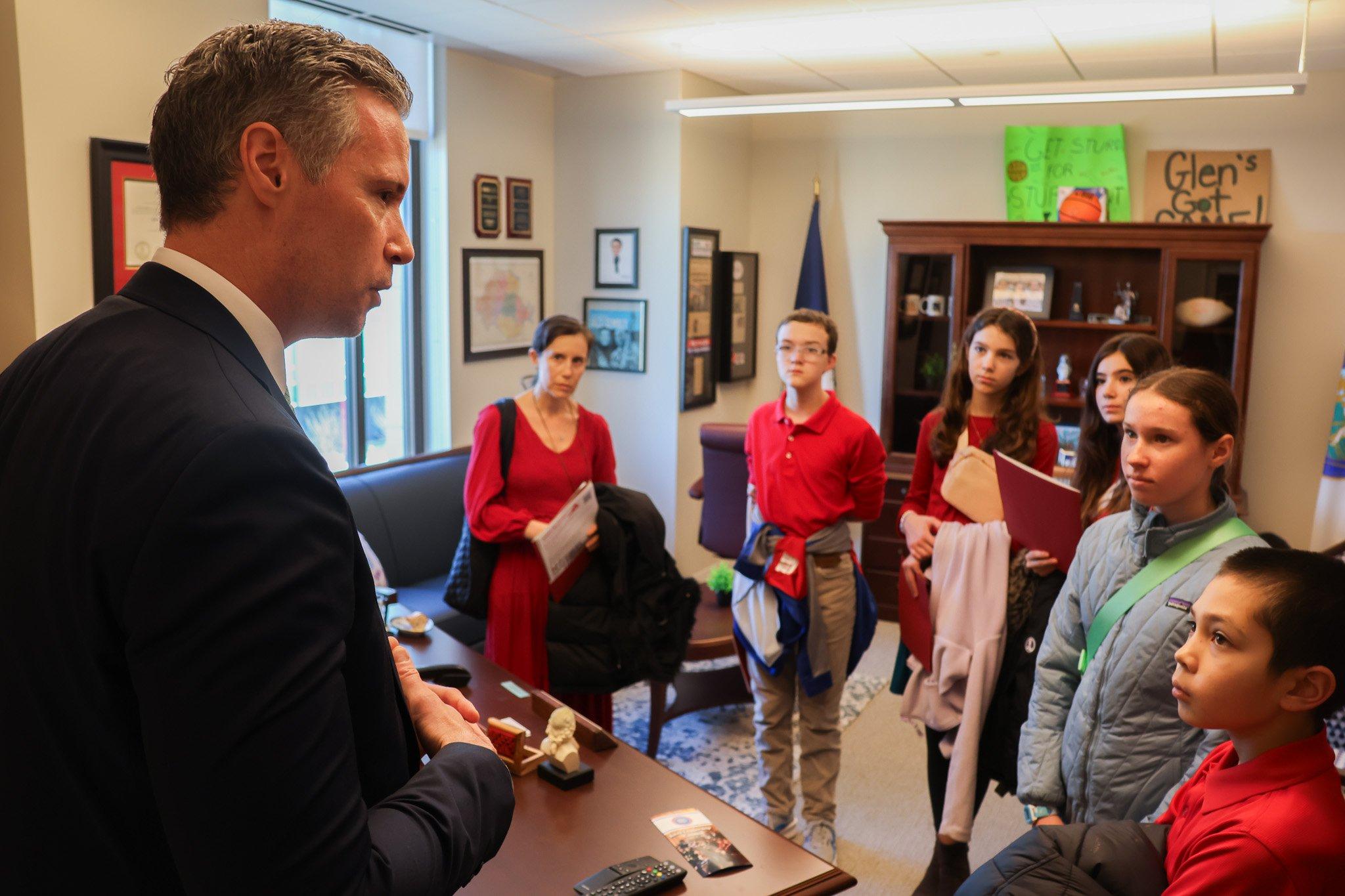
Republican Virginia State Sen. Glen Sturtevant meets with students in his office at the General Assembly Building in Richmond during Virginia Pro-Life Day Jan. 15, 2026. (OSV News photo/Claire Bebermeyer, Diocese of Richmond)
RICHMOND, Va. (OSV News) — The Virginia General Assembly has sent a sweeping amendment enshrining a “fundamental right” to abortion in the Constitution of Virginia to a statewide referendum on the November ballot.
If the voters approve the amendment, it will establish virtually unlimited abortion at any stage of pregnancy as a “fundamental right” in Virginia’s constitution.
Virginia Pro-Life Day
The amendment passed the General Assembly Jan. 16 despite the best efforts of the bishops and more than 600 pro-life advocates who met with legislators a day earlier, on Virginia Pro-Life Day.
Two proposed changes to the amendment were voted down: first, a proposal to keep the current parental consent law enforceable; second, a “born-alive” protection that would guarantee the right to medical care for a child born despite an attempted abortion.
The parental consent law currently upholds parental rights in decision-making for minors under 18 on a variety of issues, including abortion, though there is a judicial override on abortion.
‘Shocking to the conscience’
Richmond Bishop Barry C. Knestout joined Arlington Bishop Michael F. Burbidge in calling the amendment “radical,” “extreme” and “shocking to the conscience” in a Jan. 16 statement.
“We will be deeply engaged in the work of helping to educate voters on these proposed amendments, and we will fight the extreme abortion amendment with maximum determination,” said the bishops.
The state Legislature first approved the proposed amendment in early 2025, but by Virginia law, the proposal must pass in two consecutive state legislatures. The House of Delegates approved the 2026 version of the amendment Jan. 14.
‘Will be most extreme in nation’
“It will be the most extreme abortion amendment in the nation. This prevents the state from regulating abortion in any way, shape or form, all the way down to inspecting clinics for basic safety standards,” said state Sen. Glen Sturtevant, a Republican, who belongs to St. Edward the Confessor Parish in Richmond.
The amendment goes far beyond even what Roe v. Wade previously allowed and provides no protections whatsoever for preborn children. It does not include any age restriction or safety standards. Besides severely jeopardizing the parental consent law, it will also impact conscience protections for health care providers.
“This amendment was drafted by very smart lawyers to look innocuous and friendly, so that people will say, ‘Oh, that’s nice. Reproductive freedom — who could be against that?'” said Sturtevant. “In practice, this amendment is going to allow a human trafficker, or an adult that gets a minor pregnant, to bring that young person to this state for an abortion. This amendment would protect that person from prosecution.”
Continuation ✠ of the Holy Gospel according to Matthew
℟. Glory be to Thee, O Lord. Matt 5:43-48; 6:1-4 At that time, Jesus said to His disciples, You have heard that it was said, ‘You shall love your neighbor, and shall hate your enemy.’ But I say to you, love your enemies, do good to those who hate you, and pray for those who persecute and calumniate you, so that you may be children of your Father in heaven, Who makes His sun to rise on the good and the evil, and sends rain on the just and the unjust. For if you love those that love you, what reward shall you have? Do not even the publicans do that? And if you salute your brethren only, what are you doing more than others? Do not even the Gentiles do that? You therefore are to be perfect, even as you heavenly Father is perfect. Take heed not to do your good before men, in order to be seen by them; otherwise you shall have no reward with your Father in heaven. Therefore when you give alms, do not sound a trumpet before you, as the hypocrites do in the synagogues and streets, in order that they may be honored by men. Amen I say to you, they have received their reward. But when you give alms, do not let your left hand know what your right hand is doing, so that your alms may be given in secret; and your Father, Who sees in secret, will reward you.
BREAKING: 1st Detransitioner to Take a Medical-Malpractice Lawsuit to Trial Wins $2 Million Judgement
Fox Varian sued her Westchester, NY, area psychologist and plastic surgeon for the gender-transition mastectomy she got at 16.
I was the only reporter to attend the entire 3-week, historic trial. Subscribe to my Substack to receive an alert about the feature article I have coming out next week in a major publication out about the trial: benryan.substack.com. I cover pediatric gender medicine as a specialty on my Substack.
Sorry to just give just a teaser for now about the case! But I wanted to get the word out about the verdict promptly, the slower pace of feature-article publishing notwithstanding.
The entire case file was put under seal when the trial started (although I obtained all those documents before they was sealed), and all the transcripts from the trial are also under seal. The riveting trial was sparsely attended and there was only one other reporter at the trial; and he only attended for part of it and, as I observed, took few notes. So my own hundreds of pages of notes from the trial will likely remain the only way for the public to learn about the all finer details of what transpired, possibly ever (or until an appeal, should that happen).
In addition to my article coming out in the media outlet soon, I intend to write a lot about what I observed and learned on my Substack over the coming weeks. Stay tuned…
Just discovered this morning while hunting for another title. Too late for me as I already purchased this one at the regular price. Sharing with readers to avail them of the savings. Available now for the low, low price of $19.95. A goodly discount.
First of all, I thank you for receiving me on 12 February, and for making public the content of our meeting, which promotes perfect transparency in communication.
I can only welcome the opening of a doctrinal discussion, as signalled today by the Holy See, for the simple reason that I myself proposed it exactly seven years ago, in a letter dated 17 January 2019.1 At that time, the Dicastery did not truly express interest in such a discussion, on the grounds—presented orally—that a doctrinal agreement between the Holy See and the Society of Saint Pius X was impossible.
For the Society’s part, a doctrinal discussion has always been—and remains—desirable and useful. Indeed, even if we do not reach an agreement, fraternal exchanges allow us to better know one another, to refine and deepen our own arguments, and to better understand the spirit and intentions behind our interlocutor’s positions—especially their genuine love for the Truth, for souls, and for the Church.
This holds true, at all times, for both parties.
This was precisely my intention in 2019, when I suggested a discussion during a calm and peaceful time, without the pressure or threat of possible excommunication, which would have undermined free dialogue—as is, unfortunately, the situation today.
That said, while I certainly rejoice at a new opening of dialogue and the positive response to my proposal of 2019, I cannot accept the perspective and objectives in the name of which the Dicastery offers to resume dialogue in the present situation, nor indeed the postponement of the date of 1 July.
I respectfully present to you the reasons for this, to which I will add some supplementary considerations.
1. We both know in advance that we cannot agree doctrinally, particularly regarding the fundamental orientations adopted since the Second Vatican Council. This disagreement, for the Society’s part, does not stem from a mere difference of opinion, but from a genuine case of conscience, arising from what has proven to be a rupture with the Tradition of the Church. This complex knot has unfortunately become even more inextricable with the doctrinal and pastoral developments of recent pontificates.
I therefore do not see how a joint process of dialogue could end in determining together what would constitute “the minimum requirements for full communion with the Catholic Church”, since—as you yourself have recalled with frankness—the texts of the Council cannot be corrected, nor can the legitimacy of the liturgical reform be challenged.
2. This dialogue is supposed to clarify the interpretation of the Second Vatican Council. But this interpretation is already clearly given in the post-Conciliar period and in the successive documents of the Holy See. The Second Vatican Council is not a set of texts open to free interpretation: It has been received, developed, and applied for sixty years by successive popes, according to precise doctrinal and pastoral orientations.
This official reading is expressed, for example, in major texts such as Redemptor hominis, Ut unum sint, Evangelii gaudium, or Amoris lætitia. It is also evident in the liturgical reform, understood in the light of the principles reaffirmed in Traditionis custodes. All these documents show that the doctrinal and pastoral framework within which the Holy See intends to situate any discussion has already been firmly established.
3. One cannot ignore the context of the dialogue proposed today. We have been waiting for seven years for a favourable response to the proposal of doctrinal discussion made in 2019. More recently, we have written twice to the Holy Father: first to request an audience, then to clearly and respectfully explain our needs and the real-life situation of the Society.
Yet, after a long silence, it is only when episcopal consecrations are mentioned that an offer to resume dialogue is made, which thus seems dilatory and conditional. Indeed, the hand extended to open the dialogue is unfortunately accompanied by another hand already poised to impose sanctions. There is talk of breaking communion, of schism,2 and of “serious consequences”. Moreover, this threat is now public, creating pressure that is hardly compatible with a genuine desire for fraternal exchanges and constructive dialogue.
4. Furthermore, to us it does not seem possible to enter into a dialogue to define what the minimum requirements for ecclesial communion might be, simply because this task does not belong to us. Throughout the centuries, the criteria for belonging to the Church have been established and defined by the Magisterium. What must be believed in order to be Catholic has always been taught with authority, in constant fidelity to Tradition.
Thus, we do not see how these criteria could be the subject of joint discernment through dialogue, nor how they could be re-evaluated today so as not to correspond to what the Tradition of the Church has always taught—and which we desire to observe faithfully in our place.
5. Finally, if a dialogue is envisaged with the aim of producing a doctrinal statement that the Society could accept regarding the Second Vatican Council, we cannot ignore the historical precedents of efforts made in this direction. I draw your attention to the most recent: the Holy See and the Society had a long course of dialogue, beginning in 2009, particularly intense for two years, then pursued more sporadically until 6 June 2017. Throughout these years, we sought to achieve what the Dicastery now proposes.
Yet, everything ultimately ended in a drastic manner, with the unilateral decision of Cardinal Müller, the Prefect of the Congregation for the Doctrine of the Faith, who, in June 2017, solemnly established, in his own way, “the minimum requirements for full communion with the Catholic Church”, explicitly including the entire Council and the post-Conciliar period.3 This shows that, if one persists in a doctrinal dialogue that is too forced and lacks sufficient serenity, in the long term, instead of achieving a satisfactory result, one only worsens the situation.
Thus, in the shared recognition that we cannot find agreement on doctrine, it seems to me that the only point on which we can agree is that of charity toward souls and toward the Church.
As a cardinal and bishop, you are above all a pastor: allow me to address you in this capacity. The Society is an objective reality: it exists. That is why, over the years, the Sovereign Pontiffs have taken note of this existence and, through concrete and significant acts, have recognised the value of the good it can accomplish, despite its canonical situation. That is also why we are speaking today.
This same Society asks you only to be allowed to continue to do this same good for the souls to whom it administers the holy Sacraments. It asks nothing else of you—no privileges, nor even canonical regularisation, which, in the current state of affairs, is impracticable due to doctrinal divergences. The Society cannot abandon souls. The need for the sacraments is a concrete, short-term need for the survival of Tradition, in service to the Holy Catholic Church.
We can agree on one point: neither of us wishes to reopen wounds. I will not repeat here all that we have already expressed in the letter addressed to Pope Leo XIV, of which you have direct knowledge. I only emphasise that, in the present situation, the only truly viable path is that of charity.
Over the last decade, Pope Francis and yourself have abundantly advocated “listening” and understanding of non-standard, complex, exceptional, and particular situations. You have also wished for a use of law that is always pastoral, flexible, and reasonable, without pretending to resolve everything through legal automatism and pre-established frameworks. At this moment, the Society asks of you nothing more than this—and above all it does not ask it for itself: it asks it for these souls, for whom, as already promised to the Holy Father, it has no other intention than to make true children of the Roman Church.
Finally, there is another point on which we also agree, and which should encourage us: the time separating us from 1 July is one of prayer. It is a moment when we implore from Heaven a special grace and, from the Holy See, understanding. I pray for you in particular to the Holy Ghost and—do not take this as a provocation—His Most Holy Spouse, the Mediatrix of all Graces.
I wish to thank you sincerely for the attention you have given me, and for the interest you will kindly take in the present matter.
Please accept, Most Reverend Eminence, the expression of my most sincere greetings and of my devotion in the Lord.
Davide Pagliarani, Superior General
+ Alfonso de Galarreta, First Assistant General
Christian Bouchacourt, Second Assistant General
+ Bernard Fellay, First Counsellor General, Former Superior General
Franz Schmidberger, Second Counsellor General, Former Superior General
“A leading cardinal and former secretary of the Roman Curia has spoken to theCatholic Heraldabout the state of the Church, the role of the papacy, and how Catholics should approach authority.
“Cardinal Gerhard Ludwig Müller, prefect emeritus of the Congregation for the Doctrine of the Faith, described the veneration of the private and political opinions of the late Pope Francis as a “heresy” and said that criticising it was his “duty”. The German prelate insisted that Catholics should not fall into a heretical leaning spiritual posture known as “ultramontanism”, which exaggerates the role and doctrines surrounding the papacy, and said they should remain conscious of the historical context in which such attitudes emerged in the 19th century.”
The loss of sacredness, the lack of centrality of God, the one-sided emphasis on the ‘meal character’ in the Mass since the introduction of the Novus Ordo: all this must be reconsidered!
(LifeSiteNews) — In an interview with Diane Montagna on January 20, 2026, Bishop Athanasius Schneider draws attention to some historical facts about the liturgical reform after the Second Vatican Council, which most bishops and cardinals ignore or are no longer aware of:
The liturgical constitution Sacrosanctum concilium was adopted on December 4, 1963, and provided guidelines for the reform of the Mass and other liturgical rites. It contained theological and pastoral principles. The actual implementation was entrusted to the Pontifical Commission (Consilium ad exsequendam Constitutionem de Sacra Liturgia). On January 27, 1965, a revised form of the order of Mass was published under the direction of the Consilium: Ordo Missae. Ritus servandus in celebratione missae … Editio typica1965. This Ordo Missae legally replaced parts of the Missale Romanum of 1962 and introduced the first changes.
In October 1967, an experimental new Mass (“Missa normativa“) was celebrated in Rome, which had been decided upon by the commission. It was another draft that no longer only slightly modified the 1962 rite. This version was presented by Annibale Bugnini, the secretary of the commission, to the first post-conciliar synod of bishops, but met with divided opinions:
About 71 bishops voted in favor (“placet”)
43 were against (“non placet”)
62 saw it only as a basis for discussion
In other words, this draft was not accepted as binding. It can be said that the majority of the synod fathers rejected the “Missa normativa” in this form and did not give a clear mandate to adopt or pursue this version (several were against it or wanted changes). Nevertheless, the process was not stopped; work on the new missal continued despite the divided response. Over several years, the texts and structure were revised, with the participation of Pope Paul VI himself. On April 3, 1969, the new missal was promulgated by the apostolic constitution Missale Romanum and was bindingly introduced on the first Sunday of Advent (November 30, 1969). This 1969 missal is the so-called Mass according to Paul VI (in ecclesiastical parlance, the “Novus Ordo Missae”). It differs considerably from the editio typica of 1965, which was already celebrated by the Council Fathers and met with no opposition among them. The change in the direction of celebration [ad orientem vs. versus populum] and the people’s altar were not envisaged by the Council.
To summarize:
1965: A revised Ordo Missae was published – a transitional version of the old Mass based on the initial impulses of the Council.
1967: There was an experimental draft (“Missa normativa“), which was not confirmed.
1969: The new missal (Missale Romanum) was promulgated, known today as the Mass according to Paul VI (often called “Novus Ordo Missae”). It implements changes that were rejected by a majority of the Synod of Bishops in 1967.
Continuation of the Holy Gospel according to Matthew
Matt 6:16-21 In that time Jesus said to his disciples: And when you fast, be not as the hypocrites, sad. For they disfigure their faces, that they may appear unto men to fast. And so on.
Homily by St. Augustine, Bishop of Hippo. Bk. ii on the Lord's Sermon on the Mount, ch. xii, tom. 4 It is evident that by these precepts we are bidden to seek for inner gladness, lest, by running after that reward which is without, we should become conformed to the fashion of this world, and should so lose the promise of that blessing which is all the truer and more stable that it is inward, that blessing wherein God hath chosen us to be conformed to the likeness of His Son. In this chapter we will principally consider the fact that vain-glory findeth a ground for its exercise in struggling poverty as much as in worldly distinction and display; and this development is the most dangerous, because it entices under pretense of being the serving of God.
He that is characterised by unbridled indulgence in luxury or in dress, or any other display, is by these very things easily shown to be a follower of worldly vanities, and deceiveth no one by putting on an hypocritical mask of godliness. But those professors of Christianity, who turn all eyes on themselves by an eccentric show of grovelling and dirtiness, not suffered by necessity, but by their own choice, of them we must judge by their other works whether their conduct really proceedeth from the desire of mortification by giving up unnecessary comfort, or is only the mean of some ambition. The Lord biddeth us beware of wolves in sheep's clothing, but by their fruits, saith He, ye shall know them.
The test is when, by diverse trials, such persons lose those things which under the cover of seeming unworldliness they have either gained or sought to gain. Then must it needs appear whether they be wolves in sheep's clothing, or indeed sheep in their own. But that hypocrites do the contrary maketh it no duty of a Christian to shine before the eyes of men with a display of needless luxury; the sheep need not to lay aside their own clothing because wolves sometimes falsely assume it.
An Iranian Christian convert and former prisoner of conscience remains incommunicado two weeks after her rearrest on unknown charges.
Ghazal Marzban, who spent two months in Evin Prison last winter after being convicted of “propaganda against the regime by chanting slogans”, was rearrested by intelligence agents at her home in Tehran on 14 January.
Her Bible and other Christian literature were confiscated, and she was then taken away to an unknown location, with no explanation given for her rearrest.
Two hours later, Ghazal called home to tell her husband she was being held in a Ministry of Intelligence detention centre, but she has not been heard from since.
Ghazal’s rearrest comes in the context of an ongoing Internet blackout and brutal crackdown on protests, with credible reports that tens of thousands have been murdered by the Islamic Republic’s security forces.
At least a dozen Christians are among those known to have been killed so far, with new reports coming in every day and including members both of Iran’s recognised Armenian and Assyrian Christian communities and unrecognised converts.
“You feel weak; you fear being overwhelmed by temptation: keep yourselves far away from occasions of sin. This is what it means to watch. Avoid the company of those who might lead you astray; flee even the shadow of anything evil; you cannot be too cautious; it is safer to be a little stricter than a little too easy. Abstain from reading books that are dangerous for you. Turn away from bad thoughts as soon as they arise: attend to some business, speak with some friend, or recite the Our Father with reverence. When you are variously tempted by the threats of the world, by false modesty, by selfishness, by provocative attitudes of others, or by the sinful pleasures of the world; when you feel urged to be cowardly, or greedy, or sensual, or to refuse forgiveness, then close your eyes and think of the Precious Blood poured out by Christ. Do not dare to say that you cannot help but sin; a little attention to these points will succeed (with the grace of God) in keeping you on the right path.
“And again, pray as well as watch. You must know that you can do nothing by yourselves; your past experience has taught you this; therefore turn to God for the will and the power; call upon Him earnestly in the name of His Son; be zealous for His holy ordinances. Is this not within your power? Do you not at least have power over the members of your body, so that you can constantly make use of the means of grace? Do you not have the power to come to church; to observe the fasts and feasts of the Church; to come to the holy altar and receive the Bread of Life? Force yourselves, at least, to do this: stretch out your hand, take the holy Body and Blood, the source of grace; this is not difficult, and you say that you truly desire to obtain the blessings He offers. What would you want more than a free gift, given ‘without money and without price’? Therefore, make no more excuses; do not complain about your wicked heart, about knowing, deciding, and not doing. Your remedy is here.
“…When He, the Lord of hosts, comes to shake the earth with terror, how many of the remnant of Israel will He find? We live in an enlightened age. The false teaching of a merely secular education makes us polite and affable. We are all clever and self-assertive. We think ourselves wise; we flatter one another; we find excuses when we become aware that we have sinned, and so, gradually, we lose the consciousness of sinning. We think our time superior to all others. ‘Blind Pharisees!’ This was our Lord’s deadly accusation against the falsely enlightened teachers of His day. Since therefore we desire to enter into life, let us constantly turn back to Christ for the two foundations of true Christian faith: humility of mind and seriousness of purpose!”
These are not the kind of posts I enjoy writing. But it would hurt me even more to pretend nothing happened.
Last night, 11:40 pm, Milano Centrale Station. While waiting for the M2 metro, a deranged North African guy steps right in front of me and aggressively demands money. I tell him I don’t have any, and out of nowhere he kicks me in the knee.
On the scale of violence it’s a small thing, but it reopened an ugly scar. A little over a year ago I was attacked from behind by two North Africans inside an M5 metro carriage and thrown to the ground: they ripped off the baptism chain I had worn my whole life.
Now in the evenings in Milan I walk around with personal defense tools. That is not normal.
Just as it is not normal that yesterday, on the platform of the main station metro, there was no one there to keep watch.
Someone might say: “you have money, take a taxi”. No, I’m not having it. Not at all.
For me, the civilization of a city is measured above all by the quality of its public services. And I always take buses and metro wherever I live. It cannot be considered a crime to do so.
I myself have been an immigrant. I’ve traveled the world, worked on 3 continents, but never have I felt so unsafe, in terms of personal physical security, as I do in Milan.
A gem in Italy as a city from a work/career point of view. But having to constantly look around, never being able to lower your guard, and jumping every time someone suddenly appears outside your field of vision… really, it’s not a nice feeling at all.
"If ever you have a fit of sadness or trouble, remember that it is because you are still attached to life, or health, or some comfort, or person, or thing that you ought to forget and despise that you may desire Jesus Christ only."
“We declare that no one can oblige us to separate ourselves from the true Church, from that Church instituted by Christ Himself and which is destined to last until the consummation of the world just as He instituted it.”
“Since religion alone… can avail to destroy the evil at its root, all men should rest persuaded that the main thing needful is to re-establish Christian morals, apart from which all the plans and devices of the wisest will prove of little avail”
Minnesota Frost forward Britta Curl-Salemme draws strength from her Catholic
What would Curl-Salemme tell a young Catholic athlete who is dreaming of one day going to the Olympics? “Live your faith boldly, especially in your sports, because we need that more than anything,” she said, adding that “you don’t have to do anything crazy, just live your faith. Keep going to the sacraments and being a good teammate, it’s going to be way more beneficial for you than winning any game or championship.”
Ultimately, Curl-Salemme does see hockey as one of her “paths to be a saint.” She said there’s a lot to learn from “the daily ins and outs of being on a team and being with tons of different people with different backgrounds and different personalities and the way that, as a team sport, you’re tested to sometimes die to yourself and put the team ahead of yourself.”
“It’s such good practice for greater life and things that Jesus is asking you to do,” she emphasized. “I kind of see it as like a little training, a little training table for heaven and for how I’m supposed to be.”
Rejection of the heresy of Modernism means rejection of its approach to the Deposit of Faith and Morals.
THE DEPOSIT OF FAITH AND THE PRIESTHOOD
By Eugene Kevane
The priesthood in this period since Vatican II, in the English-speaking world at least, is torn by a deep division. It is an incipient schism and more than a schism for it arises from a fundamental heresy with regard to the Deposit of Faith and Morals. This underlying cause of the present suffering of the Church needs to be uncovered and analyzed. Only by identifying and removing this cause can we priests of today help to heal it.
St. Paul uses the Greek word "paratheke," "deposit," meaning something precious entrusted to a depositary for safekeeping. He means by it not an inert object like gold or diamonds or a sum placed in the trust department of a bank, but a living body of doctrine. "O Timothy, guard the 'paratheke,' the deposit" (1 Tim. 6:20). This urgent appeal of the Apostle to his Successor is not only thematic for the "Acts of the Apostles" and their Epistles but also for the Gospels. The reason is the fact that this deposit is the doctrine and the teaching program which Jesus entrusted to his Apostles when he taught them, and mandated them to take it out to all nations (see Matt. 28:16-20). He entrusted it therefore also to their Successors, including the men of Holy Orders as a whole until his Second Coming at the end of the world. This concept of a priceless divine deposit entrusted to the teaching Church belongs to the New Testament as one of its principal themes.
The origin of the deposit, then, is Jesus the Divine Teacher. It originated in his teaching of his Apostles, when he prepared them to carry his program forth to all nations. What is the value of the deposit? Unique and priceless. Jesus himself states it: "My teaching is not mine, but his who sent me" (John 7:16). It is the Word of God, not diffused throughout the Hebrew Scriptures, but gathered into a brief teachable synthesis and summary by Jesus himself. It was a stroke of genius, humanly speaking, that Jesus made his revelation of the Three Divine Persons the pattern of this teachable summary of divine revelation. Jesus was preparing teachers in the age-old oral methods of mankind; printing, printed catechisms and printed textbooks were still fifteen centuries in the future.
The natural tendency is to get sexual pleasure from another person even at great harm to the other person. Again, over the years in dealing with so many people, the passion for sexual experience can be so strong that not only, say, for the person not show love in marriage, genuine selfless love, and yet expect a marital embrace.
One will even resort to the most extreme measures to satisfy one’s pleasure and that whether either with one’s spouse or even with someone else. The passion of sex is the single most revealing manifestation of selfish desires. And that is why our nation, which has become, I think I can say this, an asylum of mentally disturbed people whose mental derangement is preoccupation with sex.
And behind this that’s the purpose of bringing out that our fallen human nature being spontaneously and congenitally selfish. Correspondingly, therefore, one’s sexual pleasure at no matter what cost to another person provided I am satisfied. I am sure I’ve said this maybe more than once here in class. When my Jesuit friend told me, remember Fr. John (Rōōk?), one of the few survivors of the Dachau Concentration Camp, remember, he was there about four and a half years, being a linguist so the Nazis kept him alive. After months of the torture in Dachau far into the night we’d sit and talk, professional people. How can human beings be so inhumanly cruel? You never knew on your way to the mess hall whether you would be shot down because part of the, well, schedule someone would regularly be shot down on the way to the meals; inoculation with some dreadful disease and then die in spasms of pain. And, for those of you who have not heard this (I’ve said this by now to, oh, a hundred or more audiences), we found that every single one of those S.S. guards as they called themselves, both men and women, every one was a sex pervert. And the two work together in the measure that a person is selfish to that extent that person’s sex passions are not in control. And in the degree to which they are out of control, to that extent is that person I use the word, bestially and, even stronger, demonically selfish.
—Fr.John Hardon, Servant of God
Excerpted from his talks (Chastity and Charity in Marriage
The Dicastery for the Doctrine of the Faith has communicated the outcome of the meeting between Cardinal Víctor Manuel Fernández and Fr Davide Pagliarani, Superior of the Priestly Fraternity of St Pius X, with the consent of Pope Leo XIV.
Rome is proposing a structured theological dialogue to clarify doctrinal questions linked to Vatican II and to identify the minimum conditions for full ecclesial communion and a canonical status for the Fraternity.
The Holy See reiterates that any episcopal ordinations carried out without a pontifical mandate would entail a break in communion; the dialogue presupposes that such initiatives are suspended.
The Fraternity will discuss the matter within its own council and will provide a response to Rome.
A French bishop has ordained a priest using the pre-Vatican II Pontificale Romanum in a ceremony that has renewed unresolved tensions surrounding the implementation of Pope Francis’s restrictions on the traditional liturgy.
On Saturday January 17, Bishop Alain Castet, the 75-year-old emeritus bishop of Luçon, ordained Brother Thomas-Marie Warmuz to the priesthood at Chémeré-le-Roi in western France. The ordination took place within the Fraternity of Saint Vincent Ferrer, a Dominican-inspired clerical fraternity known for its exclusive use of traditional liturgical rites. During the same ceremony, Brother André-Marie Mwanza was ordained as a subdeacon.
The ordination was conducted according to the Pontificale Romanum in force before the reforms of the Second Vatican Council. The Vatican’s Congregation for Divine Worship and the Discipline of the Sacraments stated in December 2021 that bishops are not authorised to confer Holy Orders using the older pontifical. That clarification was issued in the form of Responsa ad dubia, responding to questions raised by Pope Francis’s motu proprio Traditionis custodes.
Traditionis custodes, promulgated in July 2021, declared that the liturgical books promulgated after the Council are the “unique expression” of the Roman Rite. It placed new restrictions on the celebration of the pre-conciliar liturgy, reversing the broader permissions granted under Benedict XVI’s Summorum Pontificum. The Pope said the measure was necessary to protect ecclesial unity and to counter what he described as an ideological use of the older rites.
The December responsa went further by addressing sacramental questions, including ordinations. They stated that the use of the older Pontificale Romanumis not permitted, even in communities where the celebration of the traditional Mass has been authorised. Responsibility for enforcing these norms lies with the diocesan bishop, acting under the authority of the Holy See.
The ceremony at Chémeré-le-Roi therefore raises questions about how Traditionis custodes and its subsequent clarifications are being interpreted and applied in practice. Bishop Castet, who led the Diocese of Luçon from 2008 until his retirement in 2017, has not publicly commented on the decision to use the older pontifical.
The call is from her number, and her voice is unmistakable- that’s my wife.
‘Babe, our son is hurt. He got in a bike wreck. I’m at the emergency room but they won’t take our insurance and I need cash to get him help. Please send me 3000 dollars as soon as you can, he’s really not doing well.’
Me- ‘Wow, that’s scary. Tell me our passphrase and then I’ll send the money.’
Her (it) - ‘What? What passphrase? This is your wife, our son is hurt. Send the money now!!’
Me- ‘I’ll call you back. I don’t believe that this is my wife. If it is, I’m sorry, but we discussed this.’
The number? Spoofed. Easy to do and there’s no way to tell if a phone number is being spoofed aside from hanging up and calling back to confirm.
The voice? AI generated. Easily done. A few seconds of audio is all it takes to create a realistic audio deepfake.
What can you do?
1) Create a family safe word or passphrase. Ours is definitely not ‘Keep Going’ although we considered it. Discuss the passphrase far away from phones or any recording device. This is as analog as possible. Don’t forget that the trigger for the passphrase is just as important as the phrase itself. So instead of asking ‘what’s the safe word?’ have a separate triggering question. For example, you could say ‘I’m eating banana cream pie’ and this would trigger your spouse to respond ‘purple velvet pillows’ if that’s the safe word.
Make it fun, silly, and easy to remember. And DON’T WRITE IT DOWN.
2) Cognitive security is an essential skill in 2026. Assume every image and video you see online is fake until proven otherwise. Expect scams and spammers, and be pleasantly surprised when it’s not.
3) Figure out a backup communication option with people who you absolutely need to be able to reach. Don’t just rely on a phone number for communication. Have redundant, ideally encrypted methods of communication with family.
What did I miss? I think (hope) Nikita is wrong on the timeframe- agentic bots like Claude bot are impressive but not quite ready to flood the phone lines in just 90 days. But I think it’s going to be a huge problem by the end of the year. I already get dozens of increasingly realistic spam calls and texts daily- it’s only going to get more annoying. Have a plan to keep your family and your finances safe!
ROME, 20 January 2026 — Bishop Athanasius Schneider has issued a forceful critique of a recent liturgy report prepared by Cardinal Arthur Roche, saying it relies on “manipulative reasoning” and “distorts historical evidence.”
The Cardinal’s two-page text—framed as a “careful theological, historical, and pastoral reflection”—was distributed to members of the Sacred College at a Jan. 7–8 consistory convened by Pope Leo XIV. Although it was not formally presented or discussed at the meeting due to time constraints, the report received significant pushback from clergy and faithful after its contents circulated in the media.
Card. Burke: "Prophétis meis"
-
Non relíquit hóminem nocére eis: et corrípuit pro eis reges.
Nolíte tángere christos meos: et in prophétis meis nolíte malignári.
-- Sanctae Mariae in Sabbat...
Sabbato post Cineres ~ Feria major
-
*Introitus*
*Ps 29:11.*
*A*udívit Dóminus, et misértus est mihi: Dóminus factus est adjútor meus.
*Ps 29:2*
Exaltábo te, Dómine, quóniam suscepísti me: ne...